US vs EU Trademarks: 6 Differences That Matter to Game Studios
An EU mark and a US mark protect the same things but are granted under different rules. Six EUIPO vs USPTO differences that shape timelines, disputes and proof of use.


An EU trademark and a US trademark protect the same things: a game's title, its logo, a character's name. The two offices grant them under different rules. The EU office, EUIPO, issues one registration covering all 27 member states and examines only the sign itself. The US office, USPTO, checks your application against existing marks and wants proof that the mark is used in commerce. Those differences decide how long registration takes, who can challenge it, and what you have to file five years later.
Below are the six differences we explain most often to studios heading into these markets, plus a filing route that lets you start with a single application and keep your priority date.
At a glance: EUIPO vs USPTO
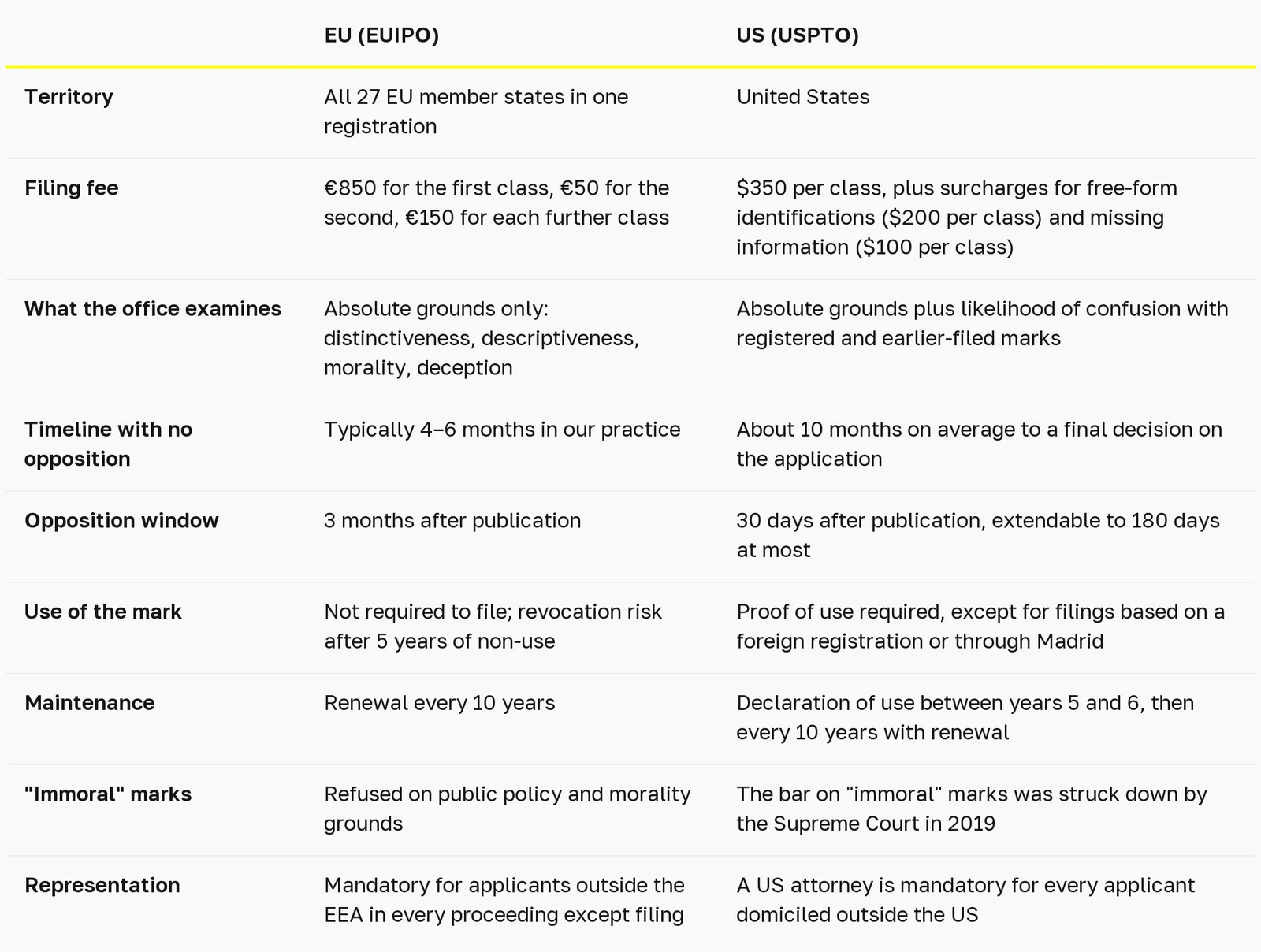
USPTO fees follow the schedule in force since January 18, 2025; EUIPO fees follow the office's fee page. The arithmetic is worth a second look. For one class, the US fee is lower than the EU fee. For three classes the totals are nearly identical ($1,050 and €1,050). The difference is that the EU money buys you 27 countries.
1. What the office examines: EUIPO does not refuse over similar marks
Grounds for refusal fall into two groups. Absolute grounds concern the sign itself: it describes the product, fails to distinguish it, misleads consumers or offends morality. Relative grounds concern other people's rights: a similar mark for similar goods is already on the register.
At examination, EUIPO checks absolute grounds only, under Article 7 of the EU Trade Mark Regulation. If a similar mark for video games is already registered, EUIPO will not refuse your application because of it. The office does run a search of earlier EU marks: you get the report if you request it at filing, and EUIPO notifies the owners of the marks it finds when your application is published, whether or not you asked for the report (Article 43 of the Regulation). Only that owner can stop the application, by filing an opposition. In practice, almost any distinctive title can sail through EUIPO examination until somebody objects.
The USPTO looks at both groups. The examining attorney searches the register and refuses on likelihood of confusion under Section 2(d) of the Lanham Act, even when the earlier owner has no idea your application exists. The refusal arrives in an office action, which you have to answer by a deadline.
Two practical points follow for a studio. A clean EU registration tells you nothing about whether the title is free, so you need a register search in both jurisdictions before filing. And EUIPO is strict on descriptive and generic words; we covered a high-profile example in why OpenAI couldn't register its own name in the EU.
2. Timelines: the EU is faster, provided nobody objects
The EU procedure is shorter because the office does not examine conflicts with third-party marks. The office checks formalities and absolute grounds, translates and publishes the application, and a three-month opposition period follows. With no opposition, the mark registers. In our practice, clean applications go through in roughly 4–6 months. It takes longer if the office asks for corrections, such as a clarified list of goods. An applicant based outside the European Economic Area will need an EU representative to handle those exchanges (Article 119 of the Regulation): you may file the application yourself, but every later proceeding before the office goes through a representative.
The US takes longer. According to the USPTO's own figures, in the first half of fiscal year 2026 the first office action arrived on average 4.45 months after filing, and a final decision on the application took about 10 months. An intent-to-use application adds a further stage, proving use (see section 4). Foreign-domiciled applicants need a US attorney throughout.
It is common for the same mark to move at different speeds in the two systems: registered in the EU within months, still pending in the US a year or more later. Build that into your announcement plan.
3. Oppositions: in the EU, rights holders do the similarity check
Since EUIPO doesn't refuse over similar marks, owners of earlier rights do that job themselves. They have three months from publication to oppose, at a fee of €320. By the office's own count, about one in five EU trademark applications is opposed. Once an opposition is filed, the parties get a cooling-off period to settle. In our practice, the usual way out at that stage is a deal: the applicant narrows its list of goods or otherwise reaches terms with the owner of the earlier mark.
The US window is shorter: 30 days from publication, extendable to 180 days. An opposition can rest on a registered mark or on rights that arose simply from using a name. Those unregistered, common-law rights are a distinctively American feature, and we'll cover them in a separate piece.
Because rights holders do the similarity check in the EU, the registration timeline depends on whether oppositions arrive. Without them, the procedure runs smoothly and takes a few months. Once they arrive, registration drags on much longer: with each opponent you either reach terms or argue the case through to an EUIPO decision, and the correspondence, agreements and attorney time cost money even in simple disputes. In our practice, a list of goods and services drafted to fit the business heads off some oppositions.
We give studios filing in the EU two pieces of advice. First, include only the goods and services you actually need the mark for. We have seen a list like that save an application from oppositions. Even a simple opposition costs time and money, since you have to contact the opponent and sign an agreement, so if you can avoid one, avoid it. Second, split the filings. File one application for the most important classes only, the ones covering the game itself: it stands a better chance of registering quickly. File the second for additional classes for a future licensing business. That business will launch later anyway, by which time you can deal with any opponents, while the core registration is already in hand.
— Futura Digital's assessment
Claims by the owner of a mark over a common word are a separate story; we covered one in our breakdown of the Figma Dev Mode case.
4. Use: the US wants evidence, the EU doesn't
In the EU you don't need to use a mark to file, and the office doesn't check. The obligation arrives later: if a mark is not put to genuine use within five years of registration (Article 18 of the Regulation), a third party can apply to revoke it. Non-use also weakens an owner in disputes. If you are opposed on the basis of a mark that has been registered for five years or more, you can require the opponent to prove it has used that mark (Article 47(2)). For a studio facing an opposition from the owner of a dormant mark, that is a real argument.
In the US, use sits at the center of the system. Under the domestic route, an applicant has two options:
- The mark is already in use (Section 1(a)). You file specimens: the game's store page, a screenshot showing the title where the game can be bought or downloaded.
- The mark will be used (Section 1(b), intent-to-use). You can file before launch, but registration only issues once you prove use. After the application is approved, the office issues a notice of allowance, and from then you have 6 months to file a statement of use. You can extend in six-month steps, up to 36 months from the notice in total. Each extension costs $125 per class, and the statement itself costs $150 per class.
A third route skips proof of use before registration. It means filing based on a foreign registration under Section 44(e), or designating the US through the Madrid System (Section 66(a)). In both cases the applicant declares a bona fide intention to use the mark, and the first time use has to be proven is the declaration between years five and six. For a game that reaches the US a year or two after registration, that matters.
This route has a condition that often gets missed. A Section 44(e) registration has to come from the applicant's "country of origin", meaning the country where it has a bona fide and effective industrial or commercial establishment or, failing that, its domicile (for a company, its principal place of business). An EU trademark works for a studio that genuinely operates in the EU, for example with an office and team in Cyprus. A company registered there with no real operations is not enough. In Kallamni v. Khan, the Trademark Trial and Appeal Board cancelled a registration based on an EU trademark because, at the time, the owner had no real establishment in the EU. A similar rule applies to Madrid: you can file an international application through EUIPO only if you are connected to the EU by nationality, domicile or a real establishment. A studio in the UAE would build this route through its own national office.
None of these routes lets you hold a mark unused indefinitely. Under US law, three consecutive years of non-use create a presumption of abandonment, and a competitor can seek cancellation on that basis.
5. Maintenance: a US registration has to be reconfirmed
An EU trademark lasts 10 years and can be renewed for further 10-year terms. There are no declarations in between.
In the US, a registration is cancelled unless the owner files a declaration of use (Section 8) in the year before the sixth anniversary of registration. There is a six-month grace period with a surcharge. After that, the declaration is due every 10 years together with the renewal. The fee is $325 per class. Marks obtained through Madrid have an equivalent Section 71 declaration, counted from the date the certificate extending protection to the US was issued.
A missed declaration cancels the registration even if the mark is genuinely in use. That is how the US registration of MECHANICAL APARTHEID, discussed below, ended: no Section 8 declaration was filed, and the USPTO cancelled it in January 2022. The register does not show whether the mark was still in use at the time. Several other countries also require declarations of use, including the Philippines, Indonesia and Mexico, so a portfolio's deadlines are easier to run from one system. That is the job of our brand protection and trademark monitoring service.
6. "Immoral" marks: refused in the EU, registered in the US
The clearest example of this difference comes from games. Square Enix tried to register MECHANICAL APARTHEID, a term from Deus Ex: Mankind Divided for the segregation of people with mechanical augmentations. In the EU it failed: the EUIPO Board of Appeal found (case R 2804/2014-5) that the sign was contrary to public policy and accepted principles of morality under Article 7(1)(f). Square Enix argued that the game comments critically on segregation; the Board was not persuaded. In the US, the same mark was registered in July 2015 for video games and online gaming services.
Since 2019 the gap has widened. In Iancu v. Brunetti, the US Supreme Court held 6–3 that the ban on registering "immoral or scandalous" marks violates the First Amendment. The case concerned the clothing brand FUCT, which the USPTO had refused as vulgar. Two years earlier, in Matal v. Tam, the Court had struck down the ban on "disparaging" marks. Today the USPTO does not refuse marks on morality grounds, while EUIPO still applies the test.
For games, where titles, factions and in-game terms are often built on provocation, this is a practical question. An edgy title will most likely pass in the US; for the EU, have a lawyer look at it first. A morality refusal in the EU has nothing to do with anyone else's rights, so there is no opponent to negotiate with. What remains is an appeal to the EUIPO Board of Appeal, as Square Enix tried, or changing the sign.
A filing route: start in the EU, reach the US within 6 months
These differences add up to a route we often suggest to studios on a tight budget.
STEP 1 — File with EUIPO
An EU application costs less per country and registers faster if nobody objects. Its filing date becomes your priority date.
STEP 2 — File in the US within 6 months, claiming priority
The Paris Convention (Article 4) gives trademarks a 6-month priority period. If you filed in the EU on November 1 and file in the US by May 1, the US application is treated as filed on November 1 (Section 44(d) of the Lanham Act). Someone else's US filing in the meantime won't get ahead of you. Many studios don't know about this window and file in the US with a fresh date.
STEP 3 — Pick the basis for the US application
If the game is already on sale in the US, the basis is use (1(a)). If launch is still ahead, it is intent to use (1(b)), with proof of use to follow. A studio with a real business establishment in the EU can wait for the EU registration and obtain the US registration on that basis (44(e)), with no proof of use until the sixth-year declaration.
STEP 4 — Add Madrid if you need more than two markets
You can base an international Madrid application on the EU filing and designate the US and any other countries you need. Keep in mind that for the first five years the international registration depends on the basic one: if the EU application falls to an opposition, the international registration falls with it to the same extent. For more on Madrid, and on when to file relative to your announcement, see "Trademark Registration for a Game: When to File".
We choose the filing order based on where the studio is incorporated and when the game ships in the US. For a studio with an operating business in the EU, the most convenient route is to file the EU trademark, file in the US within six months claiming EU priority, and once the EU mark registers, move the US application onto a 44(e) basis. The first US check on use then comes only between years five and six. A studio outside the EU gets the same priority, but its US application has to rest on use or intent to use, with proof due within three years of allowance. Either way, we search the title in both registers before filing, because in the EU a similar mark only blocks the application once its owner opposes.
— Futura Digital's assessment
What to put in your launch plan
- A clearance search in both jurisdictions. A clean EU registration doesn't mean the title is free: EUIPO doesn't refuse applications over similar marks.
- A precise list of goods. It cuts EU oppositions and makes proving use in the US easier.
- The priority window. Six months from your first filing to cover other countries with the same date.
- A declarations calendar. In the US, between years 5 and 6 and every 10 years after. Missing one cancels the registration.
- An EU check for provocative titles. A morality refusal can't be negotiated away.
We handle trademark filings in the EU, the US and other countries as part of our IP and content practice. If you need a filing route for your game and markets, get in touch about trademark registration, and we'll start with a search on your title.


Discuss
the Task
Speak to our team
Speak to our team. Tell us about your task –
we’ll help you with it in any jurisdiction.