OpenAI Couldn't Trademark Its Own Name in the EU: What the Case Teaches Game Studios
The EU office refused OpenAI protection for its own name, holding it descriptive. What that means for a game title and when to file.
One of the most recognizable companies in the world is left without a trademark on its own name in the European Union. On 15 July 2026 the General Court of the EU in Luxembourg confirmed that the word "OpenAI" can't be protected as a word mark, because the public reads it as a description of the technology rather than as a pointer to a specific producer.
For a studio, that's a convenient prompt to check what its own name is made of and whether it would survive the same test.
What happened
The General Court of the EU dismissed OpenAI's appeal and upheld the EUIPO's partial refusal to register the word mark OPENAI. Coverage in France24 and the specialist outlet agrees on the core point: the court found the sign descriptive.
The facts of the case, briefly:
- Case: T-555/25, OpenAI, Inc. v EUIPO, General Court of the EU (Luxembourg).
- Decision date: 15 July 2026.
- Classes refused: 9 (software), 42 (cloud and SaaS), 45 (identity verification).
- Ground: descriptiveness, Article 7(1)(c) of Regulation (EU) 2017/1001.
The application took three years to run its course. OpenAI filed on 15 June 2023. The EUIPO examiner refused on 5 December 2024, the office's Board of Appeal dismissed the appeal on 10 June 2025, and the General Court confirmed the refusal on 15 July 2026.
One detail matters: this isn't the end. OpenAI can still appeal to the Court of Justice of the EU (CJEU), and separately the EUIPO will consider the fallback argument of acquired distinctiveness (Article 7(3) — where a sign becomes recognizable through long use). OpenAI's figurative logo (registration 018674416) was untouched by the refusal: only the word came under fire.
Why "descriptive" was enough for the court
A trademark protects a sign that points a buyer to the source of a product. "Nintendo" describes nothing, which is why it works confidently as a mark. "OPEN" + "AI" the court read literally: "open" means publicly available, "AI" means artificial intelligence. Together it reads as "publicly available AI" — a characteristic of a whole product category that dozens of other services fit.
The everyday version of the logic is simple. Picture a bakery trying to register the words "Fresh Bread" as a mark. Such a name describes the product and would suit any competitor, so no one gets a monopoly on it. With "publicly available AI" the court reasoned the same way.
— Futura Digital's assessment
OpenAI brought two solid arguments, and the court rejected both:
- "The word open is ambiguous, and OpenAI is a neologism." The court answered that in the context of software and cloud, the public reads the combination unambiguously, as a description.
- "The mark is registered in more than 30 countries, including the UK and Singapore." For the EUIPO, foreign registrations carry no weight: assessment in the EU is autonomous and doesn't depend on other offices' decisions.
In autumn 2025 the EUIPO already acted on this same logic when it invalidated the GPT, GPT-3 and GPT-4 marks as a generic technical term. The "OpenAI" word case continues the same line.
The jurisdictions are worth separating out. In the US in July 2025, OpenAI instead won a dispute against a competitor with the similar name "Open AI": a different office, a different law, a different outcome. The European refusal has no bearing on the American win, or the other way around. That's the territoriality lesson in itself.
What's protected and what's left unprotected
The word refusal didn't strip OpenAI of all rights. It helps to see the whole picture.
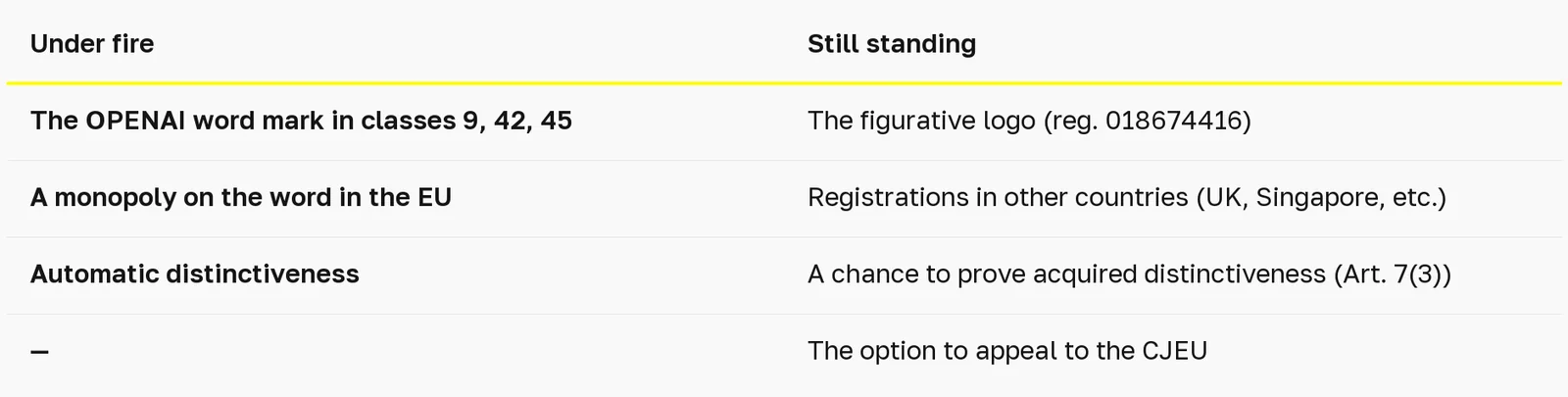
Even a giant with worldwide recognition is left without a word mark on its main name. It still kept the logo, national rights and fallback legal routes. There's no total loss of protection here, yet the most direct instrument — the word — turned out to be closed off.
What this means for studios
The name of a game, a studio, or an in-game mode goes through the same test as "OpenAI." Here's what to take from the case.
- Test your name for descriptiveness. A "common word + category" pairing ("Battle Arena," "Open World," "AI Companion") is weakly protected as a word mark in the EU. The closer the name sits to a description of the genre or feature, the higher the risk of refusal.
- Don't count on one country's registration to cover the EU. Assessment in the European Union is autonomous. A mark that sailed through in the US or the UK can still be refused in the EU for descriptiveness.
- An early filing doesn't cure descriptiveness. OpenAI filed in 2023 and was refused anyway. Timing matters for other reasons — we have a separate breakdown on those — but it won't rescue an early filing of a descriptive name.
- Bet on invented words and a logo. A made-up name ("Fortnite," "Valorant") is distinctive by definition. A logo is protected separately from the word, and in OpenAI's case that's exactly what survived.
- Prepare a fallback recognition argument. If the name is already descriptive, acquired distinctiveness (Art. 7(3)) remains a chance. The bar is high: you need evidence of recognition across every EU country.
The practical takeaway is short: a descriptive name is cheaper to change at the prototype stage than to defend in court after release.
Frequently asked questions
Can anyone use the OpenAI name now?
No. The refusal concerns registration of the word mark in the EU. The logo is protected, registrations in other countries stand, and fallback legal routes remain. This is about one protection tool, not a total loss of rights.
Our name is descriptive. What should we do?
Assess how close the name sits to a description of the genre or feature. Workable routes are adding a distinctive element, betting on the logo, or gathering evidence of recognition for the acquired-distinctiveness argument. Best to check the specifics with a lawyer for your jurisdiction.
We registered a mark in the US. Does it apply in the EU?
No, marks are territorial. Assessment in the EU is autonomous: a US registration doesn't predetermine its result. To operate in the European Union you need a check and a filing through the EUIPO.
This material was prepared by the Futura Digital team. It's an informational overview, not legal advice: trademarks apply by jurisdiction and the status of specific cases changes, so your project needs a separate check.
Discuss
the Task
Speak to our team
Speak to our team. Tell us about your task –
we’ll help you with it in any jurisdiction.