Loot Boxes, Wagering and Casino Simulators in the UAE: GCGRA Licence
In UAE law about commercial gaming, "gaming" actually means gambling. The three elements that pull a game mechanic under a GCGRA licence.
In UAE commercial gaming law the word "gaming" means gambling, and the licence follows the mechanic that hits three elements. The elements are plain: a stake of money, in cash or cash equivalents, an element of chance, and a prize — a sum of money or other valuable items — and that is how the regulator's own definition of commercial gaming is built. Elsewhere in Emirati government material the same word points somewhere else entirely: the Dubai Films and Games Commission works on video games, and a GCGRA licence has nothing to do with its remit. Genre, the absence of the word "casino" in the title, and the absence of a cash-out decide nothing on their own. Below: how the prohibition and its exception fit together, where loot boxes and social casinos land inside that frame, and what a studio already sitting in the UAE should do.
Two layers: the ban and the exception to it
UAE regulation reads more easily once you hold two layers in mind.
The first is the general prohibition in the Penal Code. Federal Decree-Law No. 31 of 2021 defines a gambling game as one in which the losing party undertakes to hand the winner an agreed sum of money or another thing. Participation draws imprisonment of up to two years or a fine of up to AED 50,000. Opening or running a place for gambling, or organising a game in a public place, draws imprisonment of up to ten years and a fine of no less than AED 100,000. Money and equipment are confiscated. The medium is irrelevant: online falls under the provision exactly as offline does.
The second layer is the exception. The founding act here is Federal Law by Decree No. (30) of 2022 on Regulating Commercial Gaming, whose full text has not been officially published; the formation of the General Commercial Gaming Regulatory Authority — the federal regulator for commercial gaming, with exclusive competence to license and supervise that activity in the UAE — was announced in September 2023. A GCGRA licence is the only route into the permitted zone.
That reframes the question for a product. What to ask is whether the mechanic falls inside the prohibition — and only then, if it does, whether a licence is available for it at all.
What the regulator treats as commercial gaming
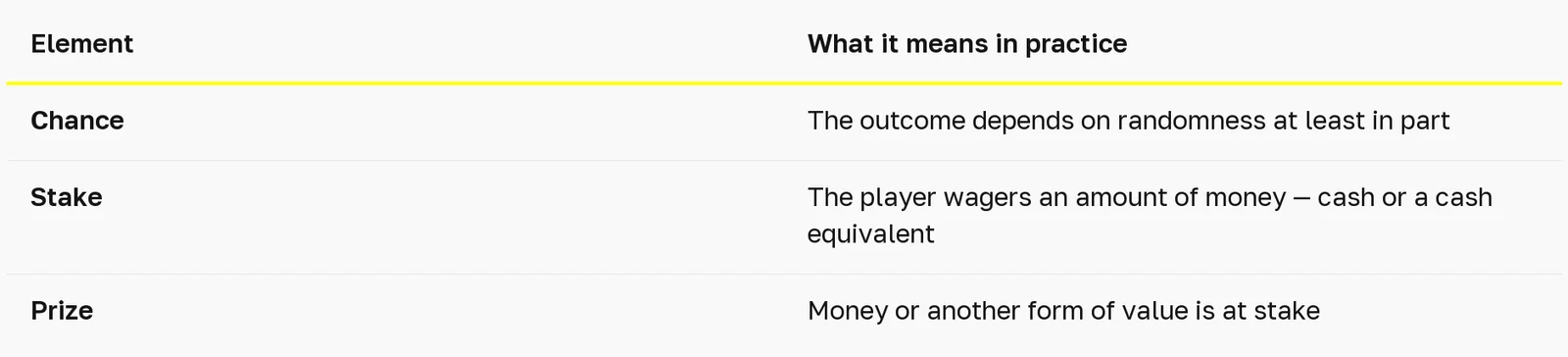
The regulator describes its subject through three elements: a game of chance, or of chance combined with skill, where an amount of money, in cash or cash equivalents, is staked with the aim of winning a sum of money or other valuable items.
Four strands sit inside that frame: the lottery, internet gaming on computers and mobile devices, sports wagering, and land-based facilities.
Two properties of this construction are worth remembering.
Skill offers no escape. The definition expressly reaches games where chance combines with skill. The argument "ours is not roulette, ours takes skill" does not work in the UAE the way it works in some other jurisdictions.
The frame is deliberately wide. Legal commentary notes that the scope was left roomy, probably so adjacent strands such as esports can be brought in later. For a product that means the safety margin has to be calculated against the upper bound of interpretation.
Five licence categories
The GCGRA issues five kinds of licence. Three attach to companies: gaming operators (facility, lottery, lottery retailer, internet gaming, sports wagering), gaming-related vendors, and key persons in a corporate capacity. Two attach to people: key persons individually, and gaming employees at two occupational levels.
The vendor category is the one developers rarely think about. A company that takes no bets itself but supplies a licensed operator with game content, an engine, a platform or tooling falls inside the licensed perimeter along that line. A developer selling its mechanic to an Emirati operator ends up where the operator is.
Loot boxes: working through the elements
The UAE has no separate loot box regulation, and the regulator has not addressed loot boxes by name. There is still something to test a mechanic against: the GCGRA publishes criteria separating commercial gaming from promotional activity, and one of them is the closest published test that can be applied to a loot box by analogy. Where a product sells well above its fair market value and a chance to win a prize is attached to the purchase, the regulator treats the construction as a lottery, which is a form of commercial gaming, because the prize is in effect sold through the inflated price. Whether a given activity falls inside the definition is a call the GCGRA reserves to itself. The analysis below runs through the elements of the definition, and the risk read on any specific mechanic is ours.
Chance. Present almost always: the contents of the box are determined at random.
Stake. The GCGRA definition draws the stake narrowly: what has to be wagered is an amount of money, in cash or cash equivalents. The "other valuable items" in the definition sit on the prize side, not the stake side — this is not the American "anything of value". Paying for a box with real money, or with in-game currency bought for money, sits inside the frame. A mechanic where the box opens only for currency the player earned in-game lands on the stake element far less confidently. That does not make it safe: the GCGRA reserves the qualification call to itself, and the fair market value test from the promotions block has not gone anywhere.
Prize. This is where the real line runs. Where the item that drops lives only inside the game and has no route back into value, the construction sits closer to buying a product with random contents. Where the item can be cashed out, sold, traded on a marketplace, or carries a working secondary market, value is at stake and all three elements converge.
The practical conclusion we give studios: what makes a loot box risky is the presence of an exit, rather than the drop rate or the price of the box. Cashability, an official or tolerated secondary market, account-to-account trading, a link to an external wallet — each of those mechanisms supplies the missing element. A studio that closes the exit technically as well as in its terms removes most of the risk; a studio that closes it only on paper keeps all of it.
— Futura Digital's assessment
A word on tokenisation. An item issued as a token comes with a secondary market by its nature, and the "there is no exit" argument stops working. A second regulator appears at the same point: token circulation lives under financial supervision, and the product acquires two frames at once.
In-game currency with no cash-out, and social casinos
A casino simulator where chips are bought for money, winnings are credited in the same chips, and reverse exchange is impossible is the most common construction and the most discussed.
Formally the third element is missing: the prize carries no value outside the game. That is what the social casino model rests on across most jurisdictions.
The construction has three weak points, and every one of them is about the facts on the ground.
- A secondary market. Accounts and chips get sold elsewhere, the operator knows and does nothing. Value appears outside the game regardless of what the terms prohibit.
- Value returning by another route. Chips exchanged for gift cards, merch, physical prizes, tournament rewards. Formally none of that is a cash-out; in substance it turns a win into value.
- A mixed economy. The game carries both a purely entertainment loop and items that can be cashed out. The regulator looks at the product whole.
Add the wide definition from the first section and a practical guide emerges: the closer a product feels to gambling and the more points of contact it has with real value, the less remains of the "we have no cash-out" argument.
What the 14 August regulators' agreement changes
The GCGRA and the Financial Services Regulatory Authority of ADGM signed a Memorandum of Understanding. It issues no licences, opens no venues and changes neither authority's powers. What it builds is a channel: supervisory coordination, policy dialogue, investigative assistance and the exchange of regulatory information.
The practical meaning for a company with an Emirati structure comes in two parts.
First, the money layer stops being separate. Payments, token issuance and the custody of player funds live under the financial regulator, while the mechanic lives under the gaming one. There is now a formal channel between them, and the picture assembles from both halves.
Second, discrepancies become visible. A product described to the financial regulator as a gaming service with no gambling component, and the same product described differently somewhere else, come into the view of both.
The agreement prohibits nothing by itself. What it signals is that regulatory capacity is being built ahead of the market's growth.
What a studio in the UAE should do
STEP 1 — Run every mechanic through the three elements
Chance, a stake of money in cash or cash equivalents, a prize of money or other valuable items. Test every monetised mechanic in the product, including the ones nobody calls loot boxes. Count the stake element where money or a cash equivalent is at risk: a mechanic that opens only for currency the player earned in-game should not trigger it on that element alone.
STEP 2 — Map every exit for value
Cash-out, exchange, account-to-account transfer, secondary market, prizes outside the game. Build the list from the facts, including what the rules forbid and players do anyway.
STEP 3 — Close the exits technically, not only in the terms
A prohibition in the rules alongside a working exchange is thin protection. The gap between the document and the product is the most exposed place.
STEP 4 — Check whether you fall into the vendor category
Supplying content, an engine or a platform to a licensed operator is licensed separately.
STEP 5 — Bring the gaming and financial pictures together
After the regulators' agreement, the product description has to match everywhere: for the payment provider, for the financial regulator, for the gaming one.
Working through specific mechanics and scoring their risk is what a loot box mechanics review and gambling compliance cover. The in-country structure gets built alongside company registration in the UAE, and the full perimeter of requirements is tested by a regulatory compliance audit.
The short version
Gambling is prohibited in the UAE by the Penal Code, and a GCGRA licence is the exception to that prohibition rather than a permitting procedure for games in general. Commercial gaming means a game of chance, or chance with skill, where an amount of money, in cash or cash equivalents, is staked to win a sum of money or other valuable items; skill does not release you from the frame, and the frame is deliberately wide. There is no separate loot box regulation, and the question turns on whether value has a way out of the game: cashability, exchange, a secondary market. Social casinos rest on the absence of the third element, and what breaks that construction is the workarounds that actually exist rather than the wording of the rules. The regulators' agreement of 14 August 2026 stitches gaming supervision to financial supervision, so the product description has to match across every document.

Discuss
the Task
Speak to our team
Speak to our team. Tell us about your task –
we’ll help you with it in any jurisdiction.