The App Store Rewrites EU Commissions on 1 October: Four Routes and What They Cost
From 1 October the Core Technology Fee goes and a 5% commission arrives. Four payment routes and what each costs a studio.

Apple is dropping the Core Technology Fee, its per-install charge, and bringing in the Core Technology Commission instead: 5% of digital sales in apps distributed outside the App Store. At the same time Apple is reworking the rates both inside the App Store and outside it: there are now four routes, each with its own rate. The announcement landed on 18 August 2026 and the terms take effect on 1 October. Developers pick how they take payment and are locked into that choice for twelve months, so the calculation has to be done now and for the year ahead.
What actually changes
The Core Technology Fee, a per-install charge paid by developers who reached extraordinary scale, is going. In its place comes the Core Technology Commission: 5% of digital sales in apps distributed outside the App Store. Two further charges disappear from the EU terms alongside it, the Initial Acquisition Fee and the Store Services Fee. For a studio with seasonal download spikes that changes the nature of the cost: the payment now tracks revenue, and you pay in proportion to what you sold.
The commission inside the App Store is being rebuilt at the same time. In the EU a developer used to pick one of two arrangements. Either Apple handles purchases of digital goods inside the app through Apple In-App Purchase, its built-in checkout, where Apple itself collects the player's money. Or the developer plugs in a payment provider of their own and runs purchases through it. Offering both in the same app was prohibited. The methods now combine, and each carries its own rate.
The four routes and their rates
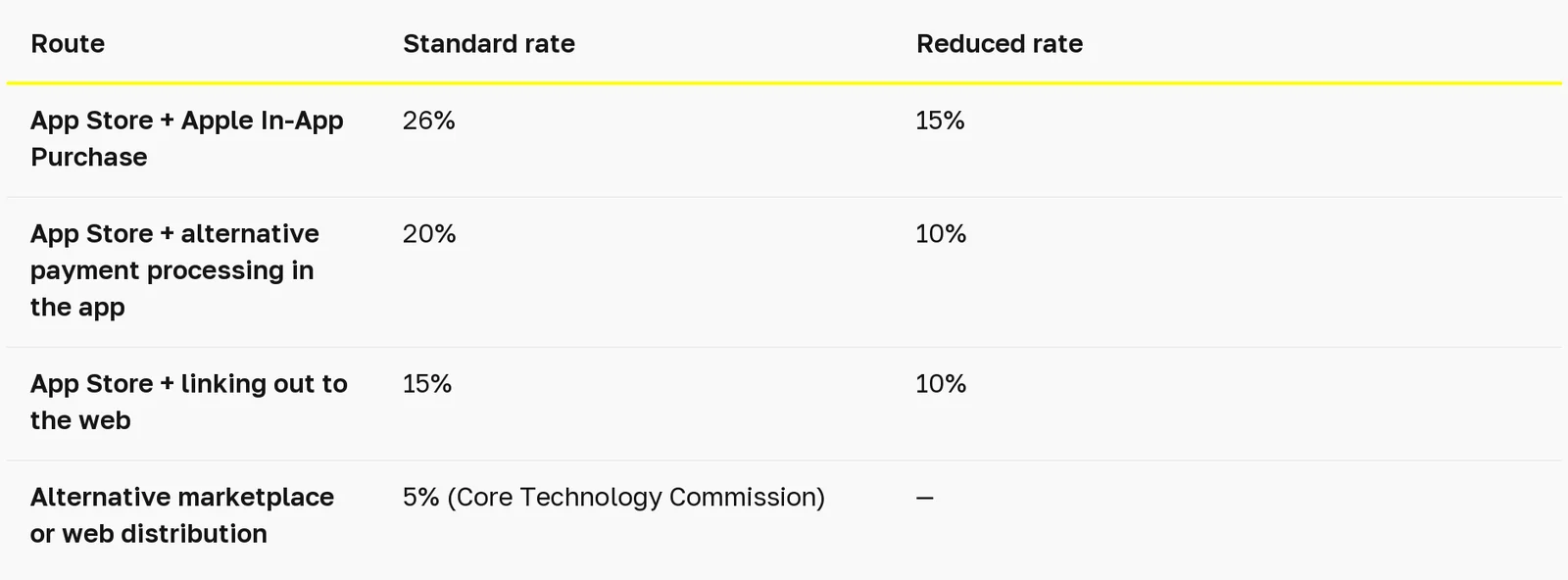
The reduced rate applies to developers in the App Store Small Business Program, the Mini Apps Partner Program and the Video Partner Program. It also covers auto-renewing subscriptions after their first year on all three App Store routes: Apple In-App Purchase, alternative payment processing and linking out to the web.
The Small Business Program threshold is unchanged: up to one million US dollars in proceeds in the prior calendar year across all of a developer's apps. Cross it during the current year and the standard rate applies to later sales; fall back below it in a future year and the 15% rate returns the year after.
Running the numbers
The headline rate is not the full price of a route. With alternative payment processing and with linking out, acquiring, chargebacks, refunds and tax reporting land on the developer. A realistic payment-provider load is two to three percent, plus your team's time.
A studio in the Small Business Program, €100,000 of digital revenue a year.
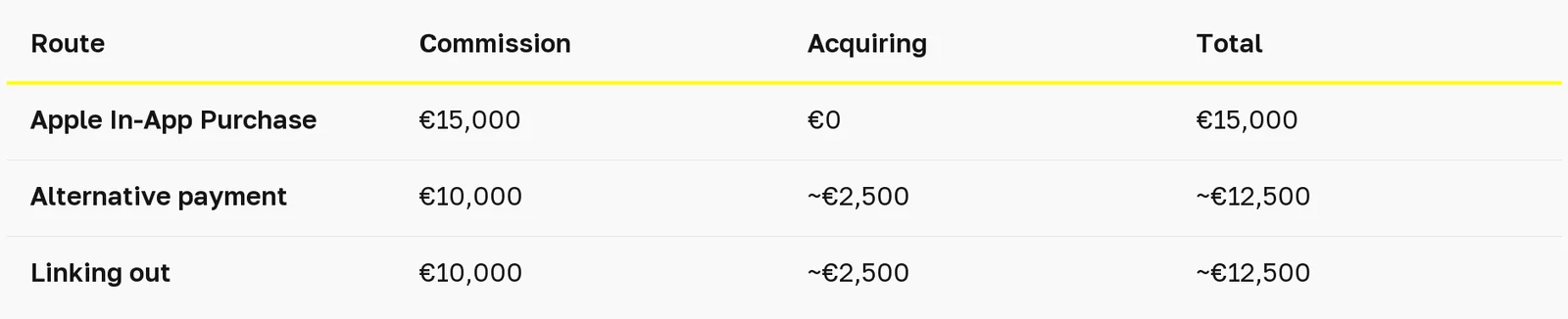
The gap is around two and a half thousand euros a year. It disappears into the first week a developer spends on the payment flow and refund handling. For a small team, Apple's own payment stays the rational choice.
A studio outside the reduced-rate programmes, €5 million of digital revenue a year.
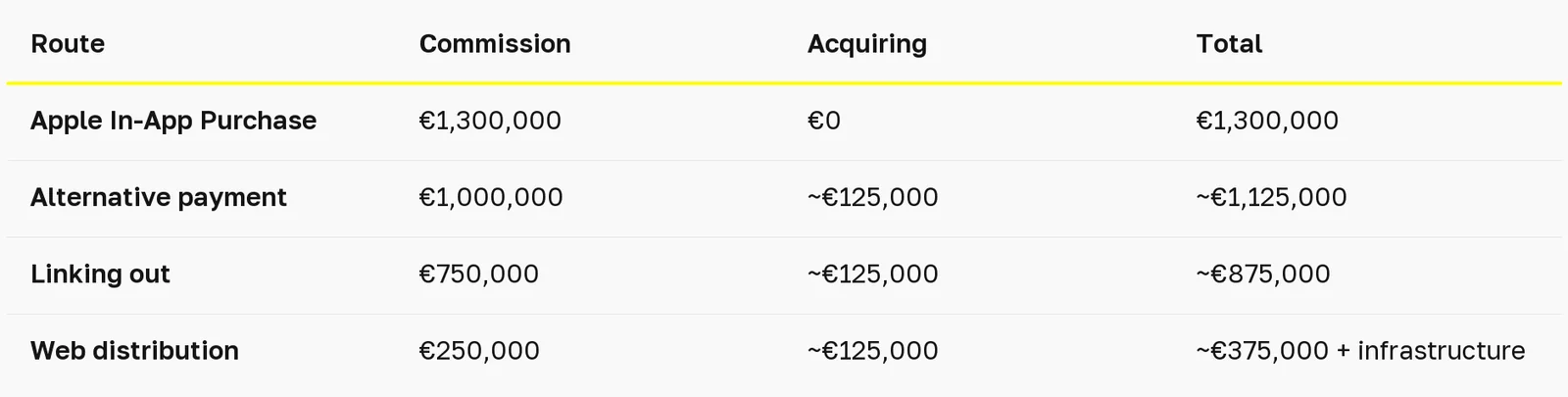
Here the spread is decisive. Apple In-App Purchase costs this studio €1,300,000 a year; web distribution comes to roughly €375,000 including acquiring. That is a difference of nearly a million euros. That is why large publishers build their own web stores and small ones do not.
The two cheapest routes, linking out to the web and web distribution, carry a cost the table does not show. Linking out loses buyers at the hand-off: the player leaves the app for a browser and conversion drops. Web distribution needs your own delivery, update and support infrastructure, along with meeting Apple's criteria for that form of distribution. Five percent is the fee rate; the full cost of the channel runs higher.
The size of your revenue is a poor guide here. What matters is its shape. Alternative routes hand you a saving in commission points, and in exchange you run your own payment stack: the provider, refunds, chargebacks, tax reporting. The point where that saving covers the upkeep sits in a different place for every studio. Subscriptions push it furthest away: every recurring charge is one more chance of a failed payment, a support ticket and a refund, so at equal revenue a subscription product generates several times the ticket volume of one-off purchases. Two studios with the same €5 million will land on opposite answers. Take your own funnel for the last twelve months and run the numbers on it.
— Futura Digital's assessment
Twelve months with no way back
Developers select their payment options — Apple In-App Purchase, alternative payment processing in the app, linking out to the web, or a combination — and must maintain those options for twelve months.
This is the most underrated condition in the package. It turns an operational setting into an annual commitment, and three situations get uncomfortable:
- A release inside the year. You pick a scheme for the current product, and four months later a game with a different monetisation model ships. The scheme is already fixed.
- Growth through the threshold. The studio crosses a million dollars in proceeds and loses the reduced rate, with no way to switch routes.
- Seasonality. A live game built around big seasonal events (a winter one, a Halloween one, a summer one) earns most of its money in the weeks those events run; an annual sports sim earns it when the new league season opens. The rest of the year is a trickle. The commission saved in the peak months has to cover the payment stack for the other ten as well: the provider, refund handling and tax reporting run all year round whatever you sold.
The practical conclusion is straightforward: the decision runs on a twelve-month forecast, and it belongs to more than the product team.
Kids' apps: separate limits
For apps with a young audience, external payments are restricted head-on:
- apps in the Kids category do not carry links to websites for completing a transaction;
- users under 18 need a parental gate — a step that requires a parent or guardian to be involved;
- users under 13 cannot be linked out to a website for a transaction at all.
For a studio this means the choice of route depends on the age profile of the audience. A game rated for younger teens loses access to the cheapest routes across part of its player base, and the economics of the two schemes have to be modelled separately. This is also the moment to check the age rating evaluation: the store category and the declared audience have to line up, or the restrictions land somewhere you did not expect.
Why Apple is doing this
The package continues Apple's dispute with the European Commission under the Digital Markets Act. In April 2025 the Commission fined Apple €500 million over rules that stopped developers steering users to cheaper ways to buy. Apple appealed and started reworking its terms at the same time: first in the summer of 2025, now with the August package, which the company itself describes as the product of working alongside the Commission.
Two things follow, and both matter for planning.
The first. The rates in this package were written under regulatory pressure, and the dispute is not over: Apple's appeal against the fine is still before the EU court. The General Court's judgment of 8 July 2026 (cases T-1079/23, T-1080/23 and T-214/24) concerns gatekeeper designation and interoperability — it is not the appeal against the fine, which runs as a separate case, T-438/25, and has yet to be decided. The terms can therefore change again, and the timing of that change is set by the progress of the case. Apple's own product calendar is secondary here. In practice that means something simple: do not build a model on the assumption that these four rates will hold for several years, and budget for a revision within the year.
The second. The whole package applies inside the European Union, and web distribution is available only there. If you sell both inside and outside the EU, the same player brings you a different margin depending on the region they pay from. That has to be separated out in the financial model, with revenue and commission counted per region. A single blended figure hides both the saving inside the EU and its absence in every other market.
What to do before 1 October
STEP 1 — Model your own funnel
Take the actual revenue of the last twelve months, split it into one-off purchases and subscriptions, and calculate the refund share separately. Without those three numbers, choosing a route is guesswork.
STEP 2 — Check your standing in the reduced-rate programmes
Membership of the Small Business Program and the one-million-dollar threshold decide half of the saving. A growth forecast for the year ahead matters more than today's status.
STEP 3 — Assess the age profile
If part of the audience is under 18, model two scenarios separately and put the parental gate into the product backlog.
STEP 4 — Record the decision as an annual one
A twelve-month commitment means the decision reaches past the product team: it needs sign-off from finance and legal, and it should be recorded together with the calculation behind it.
Changing the payment model pulls documents along with it: terms of use, refund policy, tax obligations on direct sales. That layer updates alongside the scheme, and it is easier to do in one pass — a store compliance audit and a rebuild of the product document package cover it.
The short version
The Core Technology Fee, charged per install, has been replaced by the Core Technology Commission: 5% of digital sales outside the App Store. There are four routes and four rates — 26%, 20%, 15% and 5% — with 15% and 10% for members of the reduced-rate programmes and for subscriptions after their first year. The saving on the lower rates is real at scale and barely visible at small revenue. The binding constraint in the package is the obligation to hold the chosen scheme for twelve months, which is why the calculation runs a year ahead. Sales structure in the EU and the paperwork that comes with it sit within IT and gamedev product launch support.


Discuss
the Task
Speak to our team
Speak to our team. Tell us about your task –
we’ll help you with it in any jurisdiction.