Which UAE data protection regime applies to your business?
A 2026 decision map for UAE personal-data rules: Federal PDPL, DIFC and ADGM scope, mixed operations, sector overlays and compliance evidence.
The UAE does not have one uniform privacy regime for every business. Federal Decree-Law No. 45 of 2021 applies across its stated territorial scope but excludes, among other categories, companies and establishments in free zones that have their own personal-data legislation. DIFC and ADGM each operate a separate data-protection framework. Mixed groups may need more than one regime mapped to the same product or dataset.
The starting question is not “where is the server?” It is which entity acts as controller or processor, where it is established, whose data it processes, in what operational context, and whether a special free-zone or sector law applies.
A four-question applicability test
- Which legal entity controls each purpose and means of processing? A brand or website is not itself the controller map.
- Where is that entity established and in what context does the processing occur? Separate mainland/federal, DIFC, ADGM and foreign entities.
- Whose data and which sector are involved? Health, banking/credit, government, security/judicial and other specially regulated data can change the analysis.
- Where do recipients, processors and group companies sit? Vendor and intra-group flows can place several contracts and transfer rules around one dataset.
Run the test by processing activity: recruitment, customer onboarding, product analytics, marketing, fraud checks, support recordings, biometrics, payments and employee monitoring may not produce the same answer.
The regime map
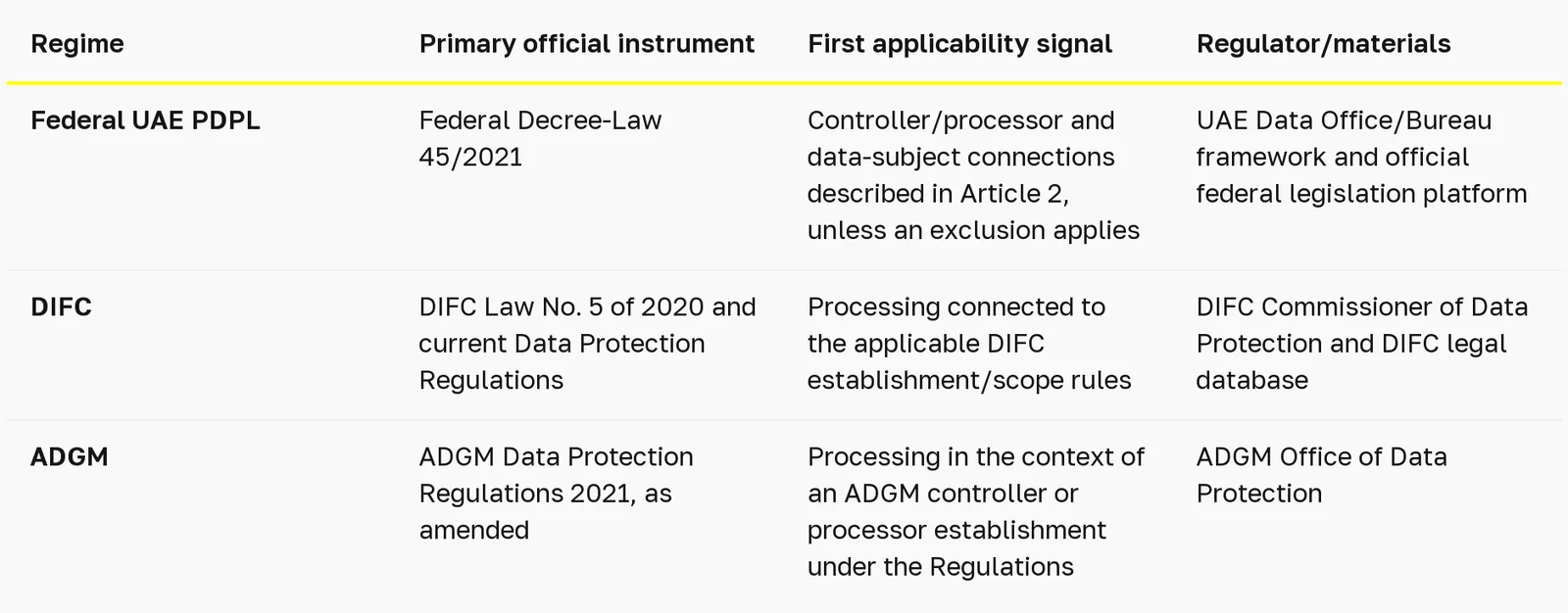
This table is a routing tool. It does not replace the territorial, material and entity-level provisions of each instrument.
Federal PDPL: scope and exclusions
Article 2 of Federal Decree-Law 45/2021 extends to the stated categories of data subject, UAE controller/processor and certain controller/processor activity outside the UAE involving data subjects inside the State.
The same Article expressly excludes:
- government data;
- government entities controlling or processing personal data;
- personal data held by security and judicial authorities;
- a data subject processing their own data for personal purposes;
- health personal data regulated by its own legislation;
- banking and credit data regulated by its own legislation; and
- companies and establishments in UAE free zones that have special personal-data legislation.
An exclusion does not mean “no privacy law”. It means the next governing instrument must be identified. A DIFC or ADGM entity, a health platform or a regulated financial operation should not stop its analysis at the federal exclusion.
For in-scope processing, the federal law contains processing principles, controller and processor duties, data-subject rights, security, impact assessment and cross-border transfer provisions. Implementation must use the current law and any in-force executive materials, not a generic GDPR checklist.
DIFC: a separate framework, recently moving
DIFC Law No. 5 of 2020 and its regulations form a separate regime administered by the DIFC Commissioner of Data Protection. The DIFC legal database is the correct freshness starting point and, as checked on 20 July 2026, lists amended Data Protection Regulations in June 2026.
That update is a warning against relying on a 2020 summary. A DIFC workstream should confirm:
- the current consolidated law and regulations;
- whether the entity is a controller, processor or both for each operation;
- notification/registration and fee obligations, where applicable;
- lawful grounds and transparency;
- processor and data-sharing contracts;
- international transfer route;
- rights handling, records, impact assessment and breach procedure.
The official DIFC guides help interpretation but do not replace the enacted text.
ADGM: establishment context and current amendments
The ADGM Data Protection Regulations 2021 apply, under their territorial provision, to processing in the context of an establishment of a controller or processor in ADGM, whether or not the processing itself takes place in ADGM. The ADGM Office of Data Protection publishes registration, breach, guidance, fee and regulatory-action materials.
ADGM’s framework also changed after 2021. In September 2025, ADGM announced new substantial-public-interest rules under the Regulations for defined special-category processing grounds. The final enacted material, rather than the consultation draft, must be used.
For an ADGM entity, check the current Regulations and rules, controller/processor registration, privacy information, legal bases, security, processor terms, transfer mechanism, record-keeping, rights and breach workflow.
One group can have three answers
Consider a group with a Dubai mainland operating company, a DIFC holding or regulated entity, an ADGM affiliate and an overseas cloud provider. The correct file is not one “UAE privacy policy”. It is a map showing:
- which company controls each processing purpose;
- whether another company acts as joint controller, independent controller or processor;
- which regime applies to each entity and operation;
- what data moves between them;
- the contract and transfer mechanism for each flow;
- which privacy notice and rights channel the individual sees;
- who investigates and reports a breach.
The same customer record may move through several regimes without making them interchangeable.
Sector overlays
Article 2 of the federal PDPL itself flags separately regulated health and banking/credit data. Other digital-business rules may also affect confidentiality, cybersecurity, marketing, consumer records, electronic communications, children or regulated financial services.
Use this sequence:
- identify the general data-protection regime;
- identify sector and activity rules;
- apply the stricter/specific requirement where the legal interaction requires it;
- document why the chosen rule applies.
Do not force sector data back into a generic PDPL matrix after the law directs it elsewhere.
The minimum evidence file
A defensible implementation should leave evidence, not only website text:
- entity/controller/processor map;
- data and systems inventory;
- purposes and lawful-ground register;
- privacy notices and consent records where consent is used;
- retention and deletion schedule;
- data-subject request workflow;
- processor/vendor due diligence and agreements;
- transfer map and mechanism;
- security measures and access governance;
- impact assessments where triggered;
- breach assessment, escalation and notification playbook;
- training, decisions and periodic review log.
The exact contents and thresholds are then adjusted for the applicable federal, DIFC, ADGM and sector rules.
Frequent mapping errors
- choosing the law from the website domain or hosting region alone;
- assuming a free-zone company is outside all federal or sector regulation;
- using one group privacy notice without naming the right controllers;
- calling every vendor a processor without checking its independent purposes;
- treating consent as the only possible basis or as a universal cure;
- copying GDPR deadlines and penalty figures into UAE documents;
- ignoring the 2025 ADGM and 2026 DIFC developments;
- claiming compliance without records, contracts or an operational rights channel.
A practical implementation sequence
- Inventory UAE and foreign entities, products and datasets.
- Assign controller/processor roles by purpose.
- Apply the Article 2 federal scope and exclusions.
- Test DIFC and ADGM scope for the relevant establishments and operations.
- Add sector overlays.
- Map recipients and international transfers.
- Build the obligation matrix and identify gaps.
- Update contracts, notices, records and operational workflows.
- Test a data request and breach scenario.
- Calendar legal and vendor freshness reviews.
For an entity and evidence review, see the UAE confidentiality and data-protection audit. This article chooses the map; the service applies it to the company’s systems and documents.
Frequently asked questions
Does the federal UAE PDPL apply in DIFC and ADGM?
Article 2 excludes companies and establishments in free zones that have special personal-data legislation. DIFC and ADGM have their own regimes. Specific entities, flows and sector rules still need to be mapped rather than answered by location alone.
Does a mainland company only need the federal PDPL?
Not always. Federal scope is the starting point, but health, banking/credit and other sector rules may apply. Relationships with DIFC, ADGM and foreign entities can also create additional contractual and transfer work.
Is GDPR compliance enough for the UAE?
No. GDPR controls may provide useful operational building blocks, but applicability, legal bases, notices, regulator interfaces, transfers and deadlines must be checked against the relevant UAE regime.
Which law applies if data is hosted outside the UAE?
Hosting location is only one fact. The controller/processor establishments, data subjects, processing context, recipients and territorial provisions decide the map.
Can a group use one privacy policy for all UAE companies?
Only if the document accurately explains the entities, roles, purposes and rights channels for the relevant regimes. A generic brand-level policy often hides the actual controllers.
What should be done first: rewrite the privacy policy or map the data?
Map the entities, purposes, systems, roles and transfers first. Otherwise the policy is likely to describe an assumed operation rather than the real one.
Official sources checked 20 July 2026. Consolidated instruments and executive materials must be rechecked before implementation. This material is general information and not legal advice.


Discuss
the Task
Speak to our team
Speak to our team. Tell us about your task –
we’ll help you with it in any jurisdiction.