What names for a game can be registered
An office will refuse a name that describes the genre or a mechanic, even if nobody has claimed it. Which words are risky and what EUIPO's Hidden Cats refusal teaches.



A game title can be registered as a trademark when it distinguishes your game from everyone else's. That is the first thing a trademark office checks: if the name simply states the genre or describes a mechanic, the office will refuse it even when nobody else has claimed it yet. Lawyers call these absolute grounds for refusal. They have nothing to do with other people's marks, and they close the door to every applicant equally.
Below we cover how offices judge a name, the words that most often drag game applications down, and what the Hidden Cats story shows. At the end there is a checklist your team can run before filing.
Absolute grounds: why an office refuses with no conflict at all
Refusals fall into two groups. Relative grounds arise when someone already owns an earlier, similar mark. Absolute grounds concern the sign itself: the office takes the view that it should not belong to any single owner.
In the European Union, absolute grounds are listed in Article 7 of the EU Trade Mark Regulation (EUTMR). Three of them matter for naming:
- No distinctive character (Art. 7(1)(b)). The word isn't perceived as pointing to a particular producer.
- Descriptiveness (Art. 7(1)(c)). The sign consists exclusively of indications that may serve, in trade, to designate the kind, quality, quantity, intended purpose, value, geographical origin, time of production or other characteristics of the goods.
- Customary terms (Art. 7(1)(d)). The sign has become customary in current language or in the established practices of the trade.
In the US, Section 2(e)(1) of the Lanham Act does the same job: a mark that is "merely descriptive" of the applicant's goods can't be registered. Marks contrary to morality and public order form a separate group. That ground is about a name's subject matter.
Both EUIPO and the USPTO examine absolute grounds. The difference lies elsewhere: during examination EUIPO does not compare your application with other people's marks and leaves that to rights holders, who can file oppositions.
The distinctiveness spectrum
Since 1976, US courts have sorted signs along the spectrum set out in Abercrombie & Fitch v. Hunting World. EUIPO doesn't formally use this scale, but its Article 7 examination follows very similar logic, so the spectrum works as a shared tool for a naming team.
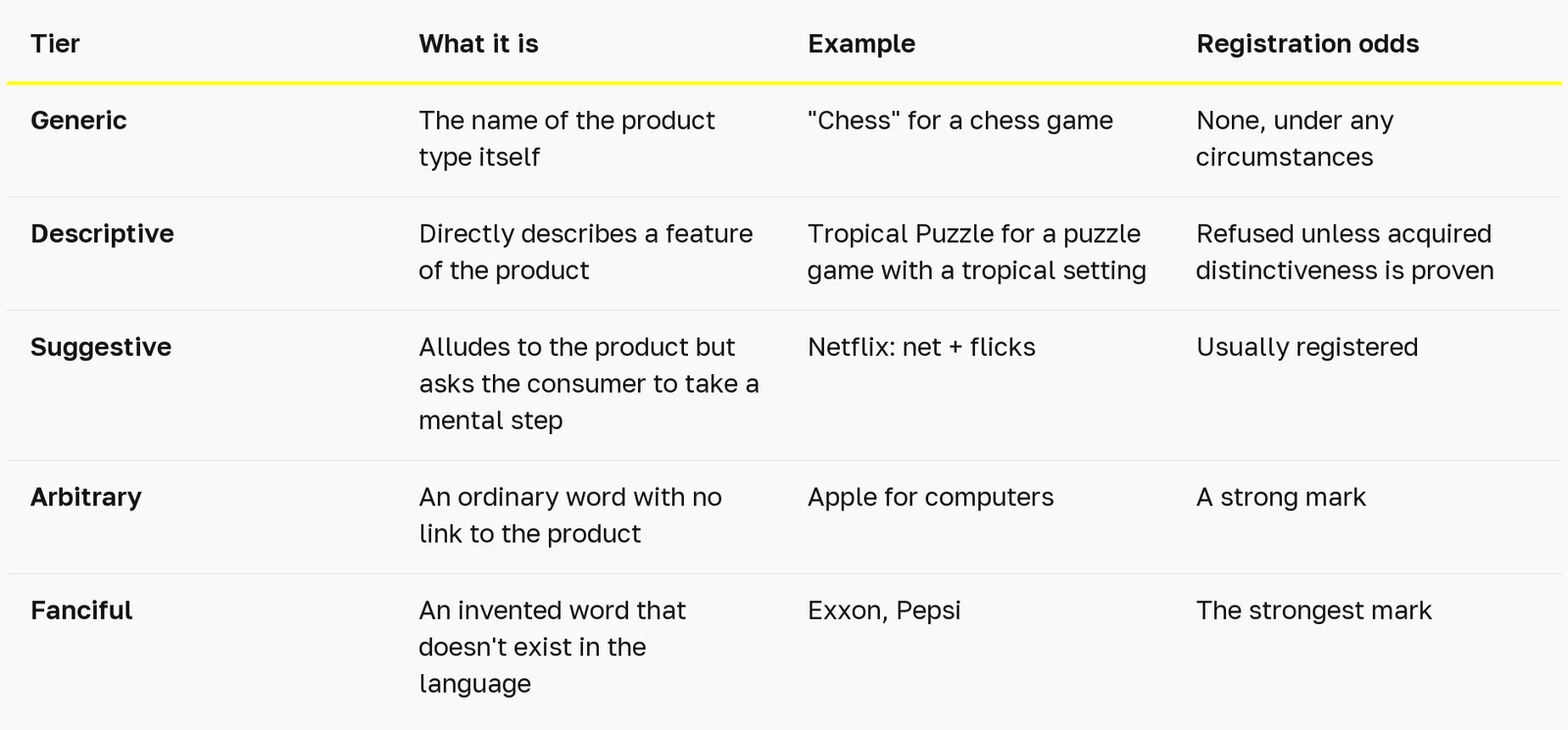
The Apple, Exxon and Pepsi examples come from the USPTO's own guide to strong trademarks. The same page gives a simple test for the line between descriptive and suggestive: a descriptive name tells you right away what the product is, while a suggestive one only alludes to it.
That line is exactly where offices stumble. The higher a name sits on the scale, the fewer questions an examiner asks and the broader the protection: a competitor will struggle to use an arbitrary or invented word even in altered form.
Trap words in game titles
Games keep reusing a set of words that describe a genre or mechanic: merge, farm, craft, town, idle, tycoon, puzzle, simulator. Players like them because they tell you at a glance what you're getting. For the same reason, offices don't.
In our practice, offices in both the US and the EU have refused game titles as descriptive. One genre word sitting next to a distinctive element gives an application a chance. A title built entirely from such words (a hypothetical Merge Farm Town) is close to impossible to register, because nothing in it points to a specific studio.
A detail of the gameplay can be descriptive too. In In re Petroglyph Games, the USPTO's Trademark Trial and Appeal Board upheld the refusal of BATTLECAM because the name described a feature of the game itself.
The reverse also happens: someone else has already registered a common word and sends you a cease-and-desist. We covered how to respond in our breakdown of the Figma Dev Mode case.
A genre word in a title is fine when a distinctive core sits next to it: an invented word, a character's name, an unexpected combination. The core is what you should register; treat the genre part as a hint for the store page. If the whole title is a description of the genre, we advise changing it: acquired distinctiveness takes years of use to prove.
— Futura Digital's assessment
Hidden Cats: why EUIPO refused a trademark for a genre name
The Hidden Cats story shows the other side of descriptiveness: a sign that many studios used before you may be one you never get, even if one country has already registered it.
Hidden Cats is a micro-genre of finding cats hidden in illustrated scenes. Independent studios have released games under that phrase on Steam for years. The Brazilian company NukeArts Serviços Gráficos (trading as Nukearts Studio) filed with the USPTO in January 2025 and on 30 September 2025 obtained registration of HIDDEN CATS, No. 7,968,484, in class 9.
NukeArts then complained to Steam, and the platform, according to the Sentinels of the Store community, told other developers to rename their games by 2 March 2026 so that no title contained both "Hidden" and "Cats". Several games were renamed: Hidden Cats: The Last of Cats, for instance, became FIND KITTENS: The last of cats.
In parallel, NukeArts filed for the same mark in the EU: application No. 019295402 of 22 December 2025, classes 9 and 41. EUIPO published it without objection, and nobody filed an opposition during the opposition period. In April 2026, though, a community member submitted third-party observations under Article 45 EUTMR, which lets anyone point the office to absolute grounds in writing without becoming a party to the proceedings. The argument was simple: Hidden Cats describes the gameplay and has long been used across the genre.
NukeArts replied to the observations that the sign is suggestive and that the studio coined and popularised it. It did not rely on acquired distinctiveness. The examiner reopened the absolute-grounds examination, and on 18 August 2026 EUIPO issued a refusal under Articles 7(1)(b), 7(1)(c) and 7(2) EUTMR, meaning lack of distinctive character and descriptiveness. The reference to Article 7(2) means a ground for refusal in part of the Union is enough, for example where consumers understand the English phrase. An appeal to the EUIPO Boards of Appeal had to be filed within two months of notification of the decision; as of 27 October 2026 the EUIPO register shows no appeal. According to the USPTO database, the US registration remains in force.
Three takeaways for naming:
- The line is contested. On the spectrum, Hidden Cats could pass as suggestive: the player has to work out that the cats are something to find. EUIPO read it as a description of the game. If a name sits on that line, plan for the less favourable reading.
- Wide use before filing works against you. The more games released under a name before your application, the easier it is to show that the name is a genre label.
- Registration in one country guarantees nothing elsewhere. The USPTO granted the mark and EUIPO refused it, for the very same phrase.
Acquired distinctiveness
A descriptive name doesn't shut the door to registration for good, and the law addresses this directly.
In the EU, Article 7(3) EUTMR allows registration of a descriptive or non-distinctive sign that has become distinctive as a consequence of use. In the US, the same rule sits in Section 2(f) of the Lanham Act: the office may accept five years of substantially exclusive and continuous use by the applicant, immediately before the claim of distinctiveness, as prima facie evidence. "Substantially exclusive" is the key phrase. If other studios have shipped games under the same name for years, as with Hidden Cats, there's little left to prove acquired distinctiveness with.
In practice, evidence of recognition for a game means player statistics by country, reviews, press coverage, advertising and media mentions. Start collecting it on day one, even if you don't need the mark yet.
The limits of morality in the EU and the US
One more absolute ground concerns provocative names. In the EU, Article 7(1)(f) EUTMR bars marks contrary to public policy or accepted principles of morality, and EUIPO does invoke it: it refused the German comedy title Fack Ju Göhte, although in 2020 the EU Court of Justice set that refusal aside because EUIPO had not taken sufficient account of the fact that German-speaking audiences did not perceive the title as morally unacceptable. In the US, the Supreme Court held in Iancu v. Brunetti, the case over the clothing brand FUCT, that the bar on "immoral or scandalous" marks violates the First Amendment. If a game title relies on shock value or a sharp political theme, budget for a refusal risk in Europe.
A naming checklist before you file
You can hand this sequence to the team choosing the name. It doesn't replace a trademark attorney's search, but it weeds out names that won't survive examination whatever the search results say.
STEP 1 — Break the name into words
List every word and ask: does it name the genre, a mechanic, the setting or the audience? If so, it's a descriptive element. If every word is descriptive, the name sits on the bottom tiers of the scale.
STEP 2 — Find the distinctive core
The name needs an element that doesn't describe the game: an invented word, a character's name, an unexpected combination. That's what you will register and enforce. No core, change the name.
STEP 3 — Check how the phrase is used in the genre
Search the name on Steam, the App Store, Google Play and gaming sites. If several other games already go by a similar phrase, it's easy to argue the phrase is descriptive or customary. That was the argument against Hidden Cats at EUIPO, and the application was refused for descriptiveness and lack of distinctive character.
STEP 4 — Check the name for someone else's brand
If the name echoes someone else's brand or a real vehicle model, a rights holder's claim adds to the risk of refusal. We've written separately about where the line runs when using real brands in games.
STEP 5 — Test the name in the languages of your key markets
How the word sounds and translates where you'll launch, and whether it has an offensive or descriptive meaning there. If some of your markets don't use the Latin script, decide in advance how the name will look in transliteration or translation: you will most likely need to register that version as a separate mark. The USPTO specifically recommends checking how a mark translates into other languages.
STEP 6 — Order a search and a registrability check
A trademark attorney runs the register search and assesses similarity and registrability. Timing is a separate decision: we covered when to file relative to the announcement in our article on when to file a game trademark.
STEP 7 — Start collecting evidence of use
Even with a strong name, keep your statistics, reviews, advertising and press coverage. If a descriptiveness dispute arises or you need to prove recognition, these materials become the backbone of your case.
We advise running this check before the name is mentioned publicly for the first time. While a name lives only in internal documents, changing it costs almost nothing. After the announcement, every change eats into the marketing budget, and wide use of your name by other studios lowers your own chances of registering it.
— Futura Digital's assessment
What to do if the name is already chosen
If the game has already shipped under a descriptive name, you have two options. One is to build evidence of acquired distinctiveness and file once there is enough of it. The other is to add a distinctive core in sequels or in a rebrand. Both decisions are worth making together with marketing, since they change how players find the game in stores.
If a competitor has applied for, or already registered, the descriptive name of your genre, Hidden Cats shows a tool that works: third-party observations at EUIPO before the opposition period ends and, once the mark is registered, an application for a declaration of invalidity on absolute grounds. An opposition won't work here: it can only be based on your own earlier right. Brand monitoring helps you spot competitors' new filings in time.
If you'd like to check a shortlist of names before the announcement, get in touch: we'll tell you which options will pass examination in your markets. All our intellectual property services are gathered under IP and Content.

Discuss
the Task
Speak to our team
Speak to our team. Tell us about your task –
we’ll help you with it in any jurisdiction.