Cyprus for GameDev and IT Founders in 2026: Tax, IP Box, and Company Setup
What relocating founders actually need to know — tax rates, residency, banking, BCS status, and IP protection in one place.



Cyprus keeps coming up in conversations about company relocation, and for good reason. It is an EU member state with one of the most founder-friendly corporate tax regimes on the continent, a dedicated fast-track programme for international tech companies, and a solid intellectual property protection framework.
At Futura Digital, we help dozens of gamedev and IT teams set up in Cyprus every year. Founders ask the same questions over and over: how does the tax actually work, what does the IP Box do in practice, how do you get banking sorted, and is BCS status worth the paperwork? This guide answers all of them, in the order founders usually face them.
Why GameDev and IT Founders Choose Cyprus in 2026
Over the past decade and a half, Cyprus has steadily built itself into a Mediterranean hub for software development, gaming, and digital business. The country joined the EU in 2004, adopted the euro in 2008, and has since positioned itself as a practical alternative to more familiar European tech jurisdictions. Without Dublin's cost base, Amsterdam's legal complexity, or Berlin's bureaucracy.
For gamedev and IT founders specifically, three things make Cyprus stand out in 2026.
- A competitive 15% corporate income tax rate paired with an OECD-compliant IP Box regime that drops the effective rate on qualifying IP income to roughly 3%.
- A dedicated Business Facilitation Unit that fast-tracks residence and work permits for foreign tech companies and their staff. Few EU jurisdictions offer anything comparable.
- English as the working language of business, a common-law legal system, and a talent pool that keeps growing thanks to inbound relocation from across the EU and beyond.
The result is a jurisdiction founders can actually understand and operate in, without translating every clause or hiring a small army of local advisors before they can sign a lease.
Cyprus Corporate Tax (15%) and IP Box (3% Effective Rate): How It Works
The standard corporate tax rate in Cyprus is 15%, applied to a company's worldwide taxable profit if the company is tax-resident in Cyprus. That already places Cyprus at the lower end of the European tax table. But the real lever for software companies and game studios is the IP Box.
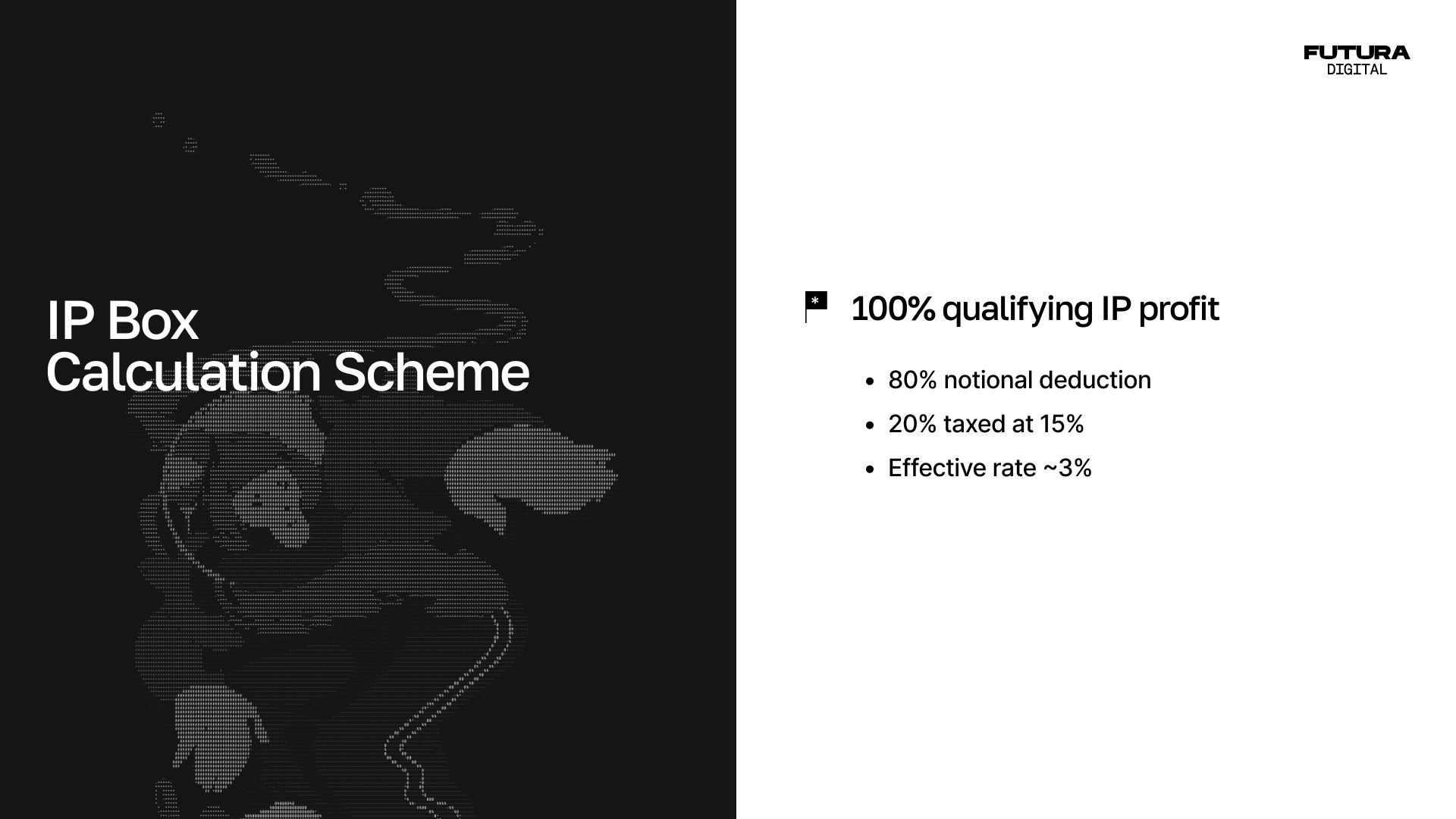
The current IP Box regime, launched after the 2016 reform, brought Cyprus in line with the nexus approach under OECD BEPS Action 5. It allows an 80% notional deduction on qualifying IP profits. The mechanics: only 20% of each unit of qualifying IP profit enters the standard 15% calculation. Net effective rate on qualifying IP income: around 3%. One of the most favourable IP regimes in the European Union.
What qualifies
The regime covers patents, copyrights in software, and other qualifying intangible assets developed through genuine R&D activity. Software copyright is explicitly included. Trade marks, brand assets, and other marketing intangibles are not.
In practice, your game's source code, engine, server infrastructure, and proprietary tooling can qualify. Your logo and game title typically do not.
How the nexus works
The 80% deduction is modulated by a nexus fraction. The fraction rewards IP you genuinely develop yourself, either through your own Cyprus-employed team or through independent contractors such as freelance developers. It penalises IP whose R&D has been pushed out to related-party affiliates. Independent contractors do not reduce the benefit; affiliate work does. Structure your R&D so the work sits with your Cyprus employees or with arm's-length freelancers, and the full benefit is available.
Dividends out
Cyprus does not impose withholding tax on dividends paid to non-resident shareholders. Those dividends will typically still be reportable and taxable in the shareholder's country of tax residence. Cyprus removes the friction at source, not the obligation at home. For founders structuring an international holding above a Cyprus operating company, that is one meaningful piece of the puzzle, but only one.
The Cyprus GameDev and IT Community
A relocation decision is never just about tax. Founders also want to know what they are walking into — who their peers will be, where the conversations happen, and how quickly they can find people who actually understand the work. In this dimension Cyprus has quietly become one of the more interesting places in Europe.
The community has grown denser every year. Three to five gaming conferences a year is now the steady rhythm — from Pocket Gamer Connects on the island to local studio summits, publisher showcases, and dedicated mobile and web3 events. Between them, the calendar fills up with monthly meetups.
GDCy (Game Developers Cyprus) runs regular sessions that draw producers, designers, programmers, and live-ops leads from the studios that have moved to the island over the past few years. Cygma sits alongside it on the industry-and-policy side — representing the sector with government and platform partners, and connecting the dots between studios that would otherwise never meet.
There is also a broader IT and startup layer: Reflect Festival in Limassol, TechIsland's founder gatherings, and a steady stream of investor and platform partner visits — Xsolla, Pocket Gamer, major publishers — passing through the island multiple times a year.
A founder who lands in Limassol on a Monday will, within their first month, have realistic chances to grab a coffee with another studio CEO, sit in on a GDCy talk, and meet two or three potential hires without ever leaving the city. That kind of network density is hard to engineer in larger jurisdictions where the community is scattered across three or four cities. In Cyprus, it is a fifteen-minute drive.
Cyprus Tax Residency and Non-Dom Status: Rules and Benefits for Founders
Cyprus offers two routes to individual tax residency, and one of the EU's most attractive regimes for high-mobility founders.
The 183-day rule
Spend 183 days or more in Cyprus within a calendar year and you become a tax resident. A straightforward path for founders who relocate in full.
Non-dom status
This is the key benefit for new arrivals. An individual who becomes a Cyprus tax resident but does not have a Cyprus domicile (broadly, someone whose domicile of origin is outside Cyprus and who has not been a Cyprus tax resident for 17 of the last 20 years) is exempt from the Special Defence Contribution (SDC). The SDC is a tax that would otherwise apply to dividends, interest, and certain rental income. The exemption applies for up to 17 years from the point of obtaining Cyprus residency. If you draw personal cash flow through dividends from an operating or holding company, the effect is material.

No inheritance tax or wealth tax
Capital gains tax is levied only on the disposal of immovable property located in Cyprus. Gains from the sale of shares, securities, and most other assets fall entirely outside the Cyprus CGT perimeter.
Incentives for foreign employees
Cyprus also offers income tax reliefs designed to attract overseas talent. Historically a 50% exemption on employment income for newly arrived high-earning professionals, plus a separate, smaller exemption for other categories. The precise thresholds and durations have been adjusted through recent tax reforms, and your specific calculation will depend on which version applies to your employment contract. The policy direction, however, is consistent: make it cheaper for founders and senior professionals to relocate to Cyprus than to most countries in Western Europe.
Setting Up a Cyprus Company: Substance, Banking, and BCS Status via BFU
Registering a private limited liability company in Cyprus is one of the more straightforward corporate procedures a founder will go through. The structural requirements are light. The substance requirements deserve careful attention.
What you need to set up a company in Cyprus:
- A Cyprus private limited liability company can be incorporated with a single shareholder, who may also serve as the company's sole director. Foreign ownership is permitted up to 100%.
- There is no statutory minimum share capital. Companies are typically registered with around EUR 1,000, and non-monetary contributions (including IP rights) are permitted, provided they are properly valued.
- A registered office in Cyprus and a company secretary are mandatory. In practice, the registered office can be the director's residence on the island if they are a Cyprus tax resident. Registration goes through the Department of the Registrar of Companies and Intellectual Property.
- The full procedure typically takes about a month from kick-off. Application drafting and registration itself take 8-12 working days, with the remainder driven by document collection. In clean cases the cycle compresses to roughly two weeks.
Substance in Cyprus
A Cyprus company is tax-resident where its management and control are exercised. To build a defensible position, founders should establish genuine local substance from the outset.
What does substance mean when setting up a company:
- Most board meetings take place in Cyprus and are documented with minutes.
- At least one director (ideally) is a Cyprus tax resident.
- The company has a real office and an operational footprint: employees, contractors, decisions made locally.
- Accounting records and reporting are mandatory, as is an annual statutory audit regardless of company size.
If your studio claims Cyprus residency, it needs to look Cypriot — to a tax inspector and to a counterparty conducting due diligence.
Banking in Cyprus
The bank is the part of the launch process that most often surprises founders. Two routes work in practice.
- Bank of Cyprus — a fully licensed Cypriot bank with a more rigorous KYC/KYB process and a requirement for in-person presence.
- Unlimit — a Cyprus-licensed payment institution that issues accounts with a local IBAN and supports remote onboarding.
Cypriot banks generally do not open accounts for sanctioned individuals or passport holders without European residency. If your beneficiary profile falls into this category, the practical solution is to start through an alternative structure with a resident partner in the initial phase, then normalise the structure after obtaining residency and establishing a local presence.
BCS status (Business Facilitation Unit)
This is one of Cyprus's quieter competitive advantages for international IT and GameDev companies. The Business Facilitation Unit within the Ministry of Interior fast-tracks residency permits and work authorisations for employees of companies with foreign participation.

Data protection
Cyprus sits entirely within the European GDPR perimeter, supervised by the Office of the Commissioner for Personal Data Protection. Any game that processes player accounts, telemetry, payment data, or behavioural analytics needs a functioning privacy programme:
- A legal basis for processing
- Transparent privacy notices
- Data processing agreements with vendors
- A retention policy
- An incident response procedure
GDPR is not a Cyprus-specific requirement. It is the baseline for operating in the EU.
IP and Employment Protection for Cyprus Studios: Copyright, NDAs, and Contracts
A studio is ultimately two assets: the team and the intellectual property. Cyprus law treats both with European rigour.
Copyright and software. Copyright in Cyprus arises automatically on creation. There is no registration system for copyright, and none is required for protection. Software is explicitly protected as a literary work under EU harmonisation. Source code, the engine, server logic, and accompanying preparatory materials are protected from the moment they exist. The term of protection follows the EU standard: the life of the author plus 70 years.
Works created in employment. Under Cyprus copyright law, where a work is created by an employee in the course of their employment, the economic rights vest in the employer by default, unless the contract provides otherwise. This is the right starting point for a studio. The position should be reinforced with explicit language in both employment and contractor agreements: a present-tense assignment of all IP rights, a waiver of moral rights to the maximum extent permitted, and representations as to originality and freedom from third-party claims. Moral rights (attribution and integrity) are non-transferable but can generally be managed by agreement.
Contractors and commissioned works. With independent contractors, the default position is different. Without a written assignment, you may find you own less than you expected. Every engagement should include an unambiguous IP assignment, a confidentiality obligation, and a warranty of freedom from third-party rights. This is also where the IP Box documentation lives: the link between R&D expenditure and qualifying income runs through these contracts.
Trade marks. Cyprus provides national trade mark registration through the Department of Registrar of Companies and Intellectual Property. Studios building pan-European brands typically file at EUIPO for a single EU trade mark covering all member states. The Madrid System allows international expansion through a single application designating target countries.
Patents. Cyprus provides national patents and, as a participant in the European Patent Convention and the Unitary Patent system, gives founders access to European protection through the European Patent Office.
Trade secrets. Cyprus has implemented the European Trade Secrets Directive (2016/943). Source code, build pipelines, monetisation tuning, and unannounced design work can all be protected as trade secrets if you take reasonable steps to maintain their confidentiality. That means real access controls, NDAs calibrated to the sensitivity of the information, and clear internal policies on what can and cannot be shared.
EU and non-EU employees. EU and EEA nationals have freedom of movement and can take up employment in Cyprus on registration. Professionals from non-EU countries require residency permits and work authorisations. This is where the Business Facilitation Unit fast-track demonstrates its value.
Managing International Contractors After Setting Up a Cyprus Company
Setting up a Cyprus company solves only one part of the operating model. Many GameDev and IT studios work with distributed teams: freelance developers, 2D and 3D artists, QA engineers, DevOps specialists, live-ops teams, and other independent contractors based outside Cyprus. For this model to support the Cyprus structure rather than weaken it, contractor management has to be treated as part of the legal and accounting system.
In practice, contractor management means more than sending payments. Each engagement should have:
- Clear written agreement
- Verified contractor details
- Defined scope of work
- Payment terms
- Confidentiality clauses
- IP assignment language
- Invoicing records
- Documented link between deliverables and payments
For software and game studios, this is especially important because code, art assets, game mechanics, backend logic, tools, documentation, and other work products may become part of the company’s qualifying IP.
This documentation also matters for the Cyprus IP Box.
- If R&D work is performed by independent contractors, the company should be able to connect agreements, invoices, deliverables, payment records, and IP assignment documents to the relevant qualifying IP income.
A clean audit trail makes the structure easier to defend during tax reviews, investor due diligence, or M&A checks.
Studios should also avoid treating contractors like employees in practice. Long-term exclusivity, fixed working hours, direct managerial control, and deep integration into the internal hierarchy may create classification risks in some jurisdictions. The safer operating model is built around defined deliverables, commercial independence, proper invoicing, and clear documentation.
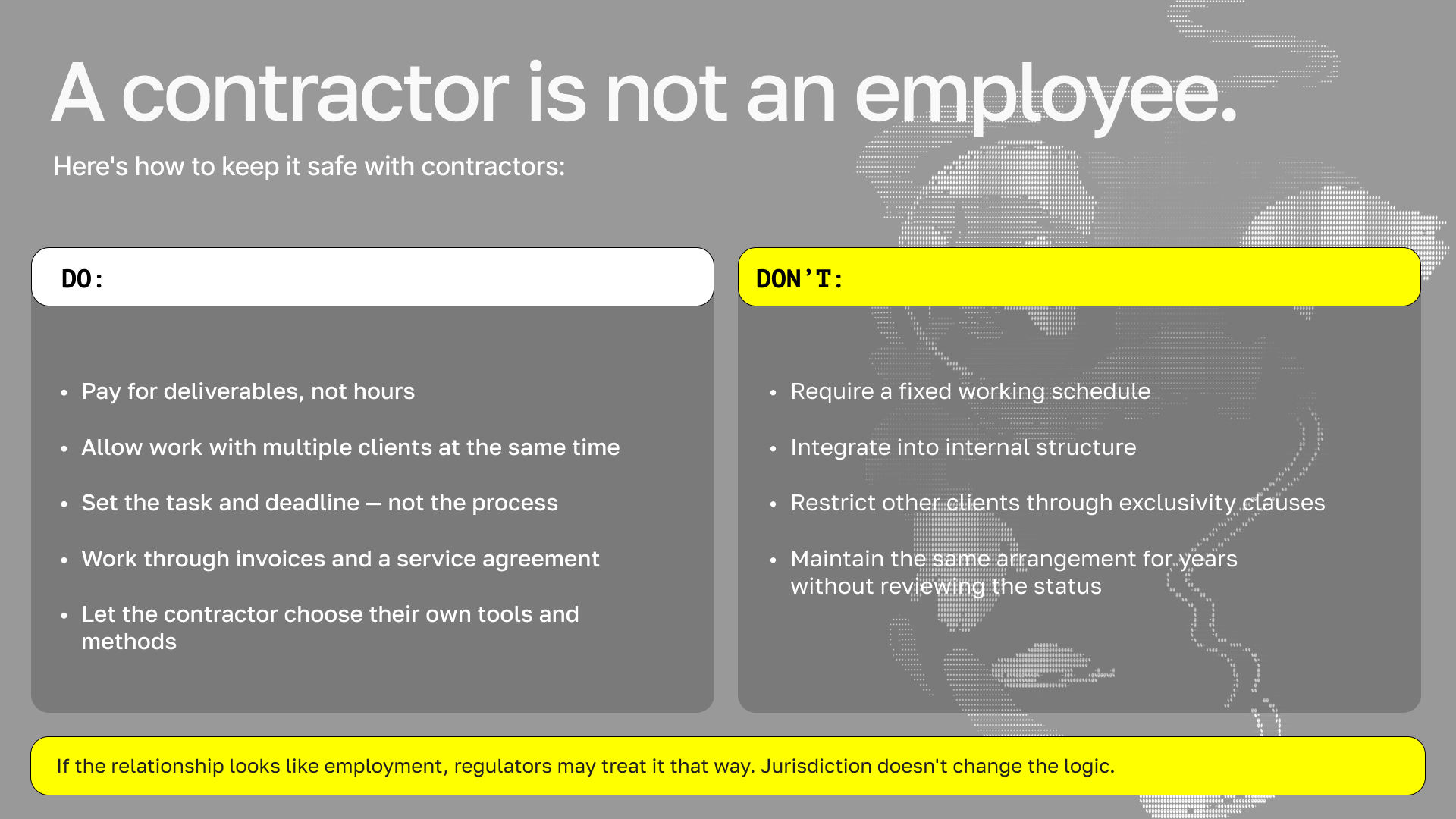
For international teams, this is where a contractor management platform or Contractor of Record provider can be useful. Instead of managing agreements, onboarding, tax documents, invoices, payment status, and IP assignment records manually across multiple countries, companies can centralise the workflow and keep a more consistent record of each contractor relationship.
4dev.com, for example, focuses on contractor operations for distributed teams: onboarding, contractor documentation, agreement workflows, invoice and payment tracking, and cross-border contractor management. For Cyprus-based GameDev and IT companies, this kind of setup can help keep the operational layer aligned with the legal structure created during incorporation.
Cyprus Relocation Checklist for GameDev and IT Studios in 2026
For a founder building or relocating a gamedev or IT studio to Cyprus, the legal architecture supports a few clear plays.
Structure the IP holding deliberately.The IP Box is most powerful when your qualifying IP genuinely sits in your Cyprus company and is developed there. Design the entity that holds the engine, the game code, and the proprietary tooling from day one.
Keep R&D on the right side of the nexus.In-house employees and arm's-length freelancers preserve the full IP Box benefit; pushing R&D out to related-party affiliates reduces it. Plan the operating model accordingly.
Build real substance from the start.Local director, real office, board meetings in Cyprus, decisions made in Cyprus, mandatory annual audit run cleanly. Substance is cheap to put in place early and expensive to retrofit during a tax dispute or a diligence process.
Lock down IP at the contract layer.Default ownership rules will only get you so far. Explicit written assignments in every employment and contractor agreement, every time, with proper warranties and confidentiality. Audit before launch.
Plan hiring around the Business Facilitation Unit.If you are relocating non-EU talent, the BCS-status fast-track shortens timelines materially. Make the BFU pathway part of your hiring playbook rather than a fallback.
Solve banking before incorporation.Pre-clear the founder profile against the bank's diligence stance, and structure ownership so the company can actually be banked.
Treat GDPR as a product requirement.Privacy by design is cheaper than a regulator's letter. Bake it into game architecture, telemetry, and live operations from the start.
Use non-dom status to align founder cash flow with company economics.Dividend, interest, and certain rental flows fall outside SDC for up to 17 years. That is a structural advantage that rewards thoughtful personal planning early.
Setting up a company in Cyprus: practical advice
Cyprus rewards founders who arrive prepared. The corporate tax architecture is competitive, the IP Box is real, the non-dom regime is generous, and the Business Facilitation Unit makes hiring across borders something you can actually do on a startup timeline. None of that happens by accident, and none of it survives a sloppy setup. The studios that get the most out of Cyprus build the entity, the substance, the IP discipline, the banking, and the employment framework deliberately, from incorporation onwards.
That is the work Futura Digital does every day with gamedev and IT founders moving into Cyprus. From entity design and IP Box structuring through to banking, BCS status, employment contracts, GDPR, and ongoing compliance, our role is to make the legal layer feel like an enabler rather than a tax on growth. If you are considering Cyprus for your next studio, the right conversation is not whether the jurisdiction works (it does). It is how to set it up so that, three years from now, it still works for the version of your business you have not built yet.

Andrey Ivashentsev
Cyprus offers a rare combination: a European jurisdiction, low IP tax, and a community that helps each other grow.



Discuss
the Task
Speak to our team
Speak to our team. Tell us about your task –
we’ll help you with it in any jurisdiction.