AI Has to Introduce Itself in the EU From 2 August: How Article 50 Works
From 2 August the EU requires AI to declare itself. Who discloses what, which systems are covered and what a breach costs.
From 2 August 2026, AI systems in the EU have to declare themselves. A person must be able to tell they are talking to a machine, and generated content has to carry a marker another machine can read.
A week before that date, the EU rewrote the AI Act calendar. Regulation (EU) 2026/1744, known as the Digital Omnibus, entered into force on 27 July and pushed the heaviest high-risk obligations back by a year or more. Transparency stayed where it was.
What moved and what did not
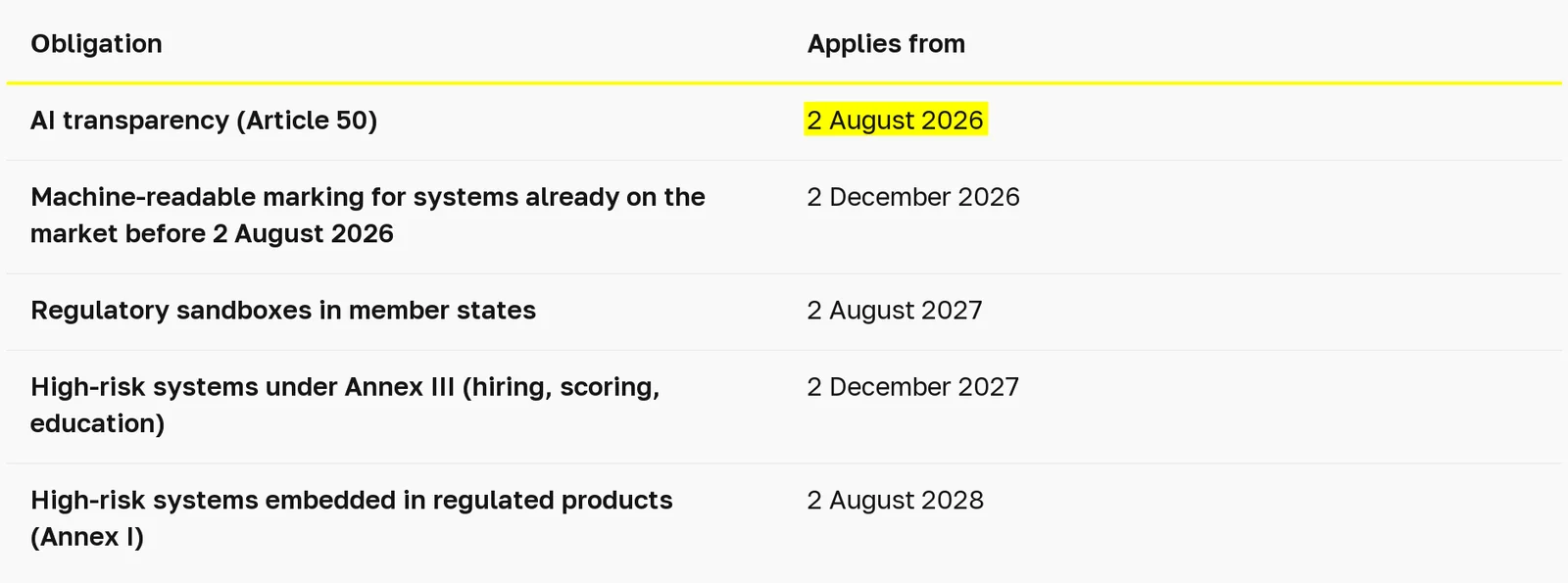
The marking deferral covers systems already placed on the EU market before 2 August and gives them until December. A product launching after that date has to mark its output straight away.
The four situations Article 50 describes
Duties are split between the party that builds the system (the provider) and the party that puts it to work (the deployer).
- The system talks to a person. Chatbots, voice assistants, AI agents, speaking characters. The provider has to design the system so the person understands they are dealing with a machine. The exemption applies where this is obvious from context to a reasonably observant user.
- The system generates content. Synthetic audio, images, video and text are marked in machine-readable form: metadata, watermarks, cryptographic provenance. The duty sits with the provider of the generator.
- The system reads emotions or sorts people by biometrics. The deployer informs the person that such a system is being applied to them.
- Deepfakes and AI text on matters of public interest. The deployer discloses that the material was machine-created or machine-altered.
Marking carves out short character sequences, source code, machine-to-machine exchanges never shown to a person, and ordinary assistive editing. Artistic, satirical and fictional works get a lighter treatment: the disclosure must not interfere with enjoying the work. Text under genuine human editorial control is exempt from the disclosure duty in Article 50(4), and a formal spell-check does not count as editorial control. That exemption leaves the technical marking duty untouched: marking sits in Article 50(2), falls on the provider of the generator and carries its own narrower carve-outs.
Why this reaches companies outside the EU
The regulation follows the output rather than the address on your incorporation certificate. It is enough that the system's output is used in the Union. No EU office, no European ad spend and no personal data processing are required to trigger it: a Dubai studio whose AI-driven game is downloaded in Germany carries the same duty as a Berlin one.
Game projects tend to hit three of the four situations at once. A character with generated dialogue is a system talking to a person. Synthesised voice work and generated assets are output that has to be marked. A promo clip built on a deepfake of a recognisable face needs disclosure from whoever publishes it.
— Futura Digital's assessment
What a breach costs
Breaching operator obligations, Article 50 among them, carries fines of up to EUR 15 million or 3% of worldwide annual turnover, whichever is higher. For small and medium companies the logic flips and the lower figure applies. Enforcement under this article runs from the date the obligation itself starts.
What is already available
The Commission published its working documents ahead of the date. The Code of Practice on Transparency of AI-Generated Content reached its final version on 10 June, and on 8 July the Commission formally confirmed that following the code discharges the marking obligations. Separate guidelines landed on 20 July.
The practical minimum recommended by law firm readiness notes:
- Map the AI in your product. Where it speaks to users, where it generates content, where it reads emotions or biometrics.
- Fix your role for each item. Provider duties and deployer duties differ, and with a vendor in the chain they are allocated by contract.
- Build disclosure into the interface. Onboarding and a visible label for chatbots, an opening line for voice flows.
- Set up machine-readable marking. Metadata and watermarks on generator output, tested to survive export and recompression.
- Record your reasoning on exemptions. A decision that disclosure is obvious enough deserves a written rationale, especially for products aimed at children.
The application date has arrived while national supervisory authorities across member states are unevenly appointed, so enforcement will ramp at different speeds. The obligation itself applies in full from day one.
FAQ
We use a third-party model through an API. Who owns the marking duty?
Machine-readable marking of output sits with the provider of the generative system. Where you embed someone else's model and ship the result under your own name, your role can shift to provider. That is the first thing to check in the vendor contract.
Our game has AI characters. Do we need an "this is AI" label on every dialogue?
The regulation asks that the person understand what they are dealing with and leaves the form open. Disclosure at onboarding and in the character description usually satisfies it. The "obvious from context" exemption exists, and the burden of justifying it is yours.
The Digital Omnibus moved deadlines. Could transparency move too?
The move already happened and is fixed in an adopted regulation. Article 50 kept its 2 August 2026 date there, and the only reprieve went to machine-readable marking for systems that reached the market earlier.
Prepared by the Futura Digital team. This is an informational overview rather than legal advice: obligations under the regulation depend on your role and on how your product is built, so your project needs its own assessment.


Discuss
the Task
Speak to our team
Speak to our team. Tell us about your task –
we’ll help you with it in any jurisdiction.