Cyprus Non-Dom in 2026: When the Status Ends and What Replaces It
After 17 years of Cyprus tax residence out of the last 20 you count as domiciled. How the clock runs and what article 3Δ offers.
Non-dom status is not permanent. After 17 years of Cyprus tax residence out of the last 20, Cyprus treats you as domiciled, and the defence contribution on dividends switches on by itself. From 1 January 2026 anyone who has served out that period has an alternative: a flat contribution instead of a contribution on actual income. Here is how the clock is counted, what the new article 3Δ actually offers, and where its traps sit.
Founders often tell us that non-dom "lasts 17 years". That is not quite right, and the imprecision is expensive: the clock runs on a rolling window, not from the date you moved, and reversing the status is close to impossible.
Who pays the defence contribution on dividends
The special contribution for defence (SDC) is charged on several kinds of income, and both individuals and companies pay it. What concerns us here is one slice of it: dividends received by an individual.
In that slice the contribution is paid by someone who is both a Cyprus tax resident and Cyprus domiciled. A person without Cyprus domicile falls outside the charge — that is what non-dom status means in practice.
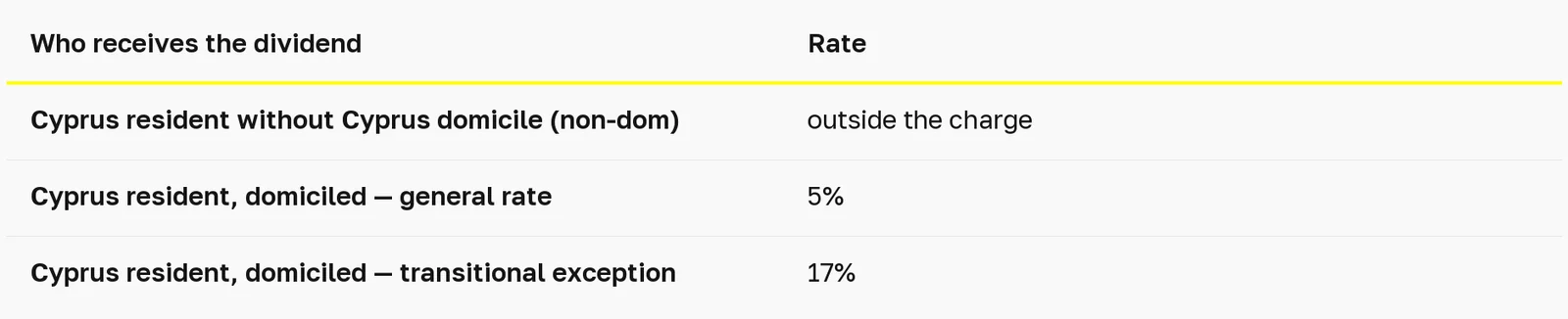
5% is the general rate: it applies whatever year the profits were earned in. The old 17% survives as a narrow exception, and three conditions have to hold at once for it to apply:
- the dividend is paid by a company that is tax resident in Cyprus;
- it comes out of profits of tax years up to and including 2025;
- it is received within six years of the law coming into force, that is by 31 December 2031.
Miss any one of them and the general 5% applies. A dividend out of 2024 profit paid in 2033 is taxed at the general rate of 5%.
Domicile by length of stay: 17 out of the last 20
The rule itself is not new: it has been in force since 16 July 2015, when Cyprus brought the concept of domicile into this law. The 2025 reform did not introduce it — it replaced the proviso wholesale, keeping the 17-of-20 count and adding a second rule about retaining the domicile. For people who moved a long time ago, the date may well have arrived long before the reform.
The wording: regardless of domicile of origin, a person who has been a Cyprus tax resident for at least seventeen of the twenty years preceding the tax year is deemed to have acquired Cyprus domicile.
The operative words are "the twenty years preceding". The window rolls and is recalculated every tax year, so the status does not simply expire in the eighteenth year after you moved. And because 17 years out of 20 are needed, up to three non-resident years inside the window are tolerated — each of them pushes the date back.
And the part that is rarely written about. Once a person is deemed domiciled under this rule, they are treated as keeping that domicile until they complete twenty years during which they are not a Cyprus tax resident. Leaving for a year to reset the counter does not work: the way back is longer than the way in.
Work out your domicile date before it arrives, not after. In our experience a founder learns about the deemed-domicile clock at the point where the year's distribution policy is already signed — and the only remaining choice is to pay.
— Futura Digital assessment
What article 3Δ offers
From 2026, a person who has no Cyprus domicile of origin but is deemed to have acquired Cyprus domicile under the 17-of-20 rule can elect an alternative regime: a flat contribution instead of the contribution on actual income.
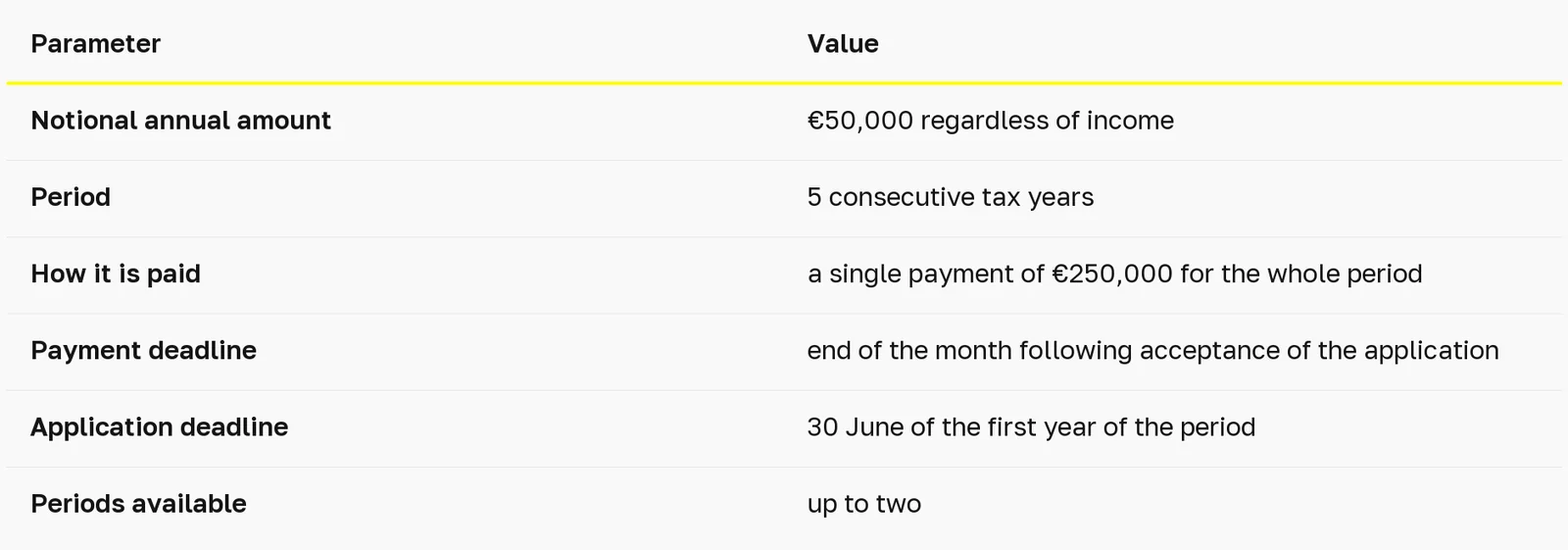
What the summaries lose: there are no instalments. The €50,000 is a notional annual figure that adds up to the five-year total. The law does not allow paying it year by year: the contribution is made as a single payment of €250,000, corresponding to all the tax years of the period at once. No choice between "€50,000 a year" and "€250,000 in one go" exists in the law.
There is one hard deadline: the end of the month following the month in which the Tax Commissioner accepted the application. Miss it and the article applies to no year of the period at all — the person is charged on income under the general rules. One missed date undoes the whole five-year decision.
The application goes in on a prescribed form and has to be accepted by the Commissioner: this is a permission regime: until the Commissioner accepts the application, the regime does not apply. The election itself is irrevocable and binding for all five years — there is no changing your mind halfway.
Three limits usually decide whether the regime is worth it:
- The amount paid cannot be set off against other tax liabilities or against credit balances.
- Nothing paid under the article is refunded, for any reason.
- No foreign tax credit is available against it.
Once the flat amount is paid, the SDC obligation for those five years is exhausted in full.
What stands in the way of a workaround
The obvious route — moving the source of the dividends to someone without Cyprus domicile — was closed long ago, but narrowly. The asset-transfer rule dates from 2015; the 2025 reform merely moved it into its own article 4Α, replacing the reference to the Director with the Tax Commissioner. It bites only where three conditions hold at once:
- the transferor has Cyprus domicile and the transferee does not;
- the transferee is a spouse, a relative of the transferor, or a relative of the spouse up to the third degree of kinship;
- the Tax Commissioner considers that the main purpose, or one of the main purposes, of the transfer is avoidance of the defence contribution.
Where that holds, income from the transferred assets falls under the contribution, and it can be collected from either party. Where the transferee is not a relative, or avoidance is not among the main purposes of the transfer, article 4Α does not apply. Having a commercial reason is not by itself a defence: purposes can coexist, and it is enough for the tax purpose to be one of the main ones.
Closer to home for a founder with a holding company is a different proviso, which sits inside article 3 itself. Where the dividend went not to the individual but to a company in which a Cyprus resident who is domiciled participates directly or indirectly — more than 50% of the voting rights, or more than 50% of the capital, or the right to receive more than 50% of its profits — and the Tax Commissioner finds that the company was interposed as a shareholder without any substantial commercial or economic purpose, its main purpose being to avoid, reduce or defer the contribution, the Commissioner may treat the dividend as paid to the individual. The contribution is then demanded either from the receiving company or from the participants. Note that plain deferral is caught on the same footing as avoidance.
What is genuinely new in 2026 is the general anti-abuse rule (article 4Β). In calculating the contribution, no account is taken of arrangements whose main purpose, or one of whose main purposes, was a tax advantage that defeats the object or purpose of the applicable tax provisions, and which are not genuine — that is, put in place without commercial reasons reflecting economic reality. That limb about the object and purpose of the provisions matters: ordinary tax planning does not fall under this article. The rule is wider than 4Α and is tied neither to kinship nor to transfers of assets.
Where to run your own numbers
The break-even is straightforward: five years of contribution at the general rate against €250,000. At 5% it lands at around €1 million of dividends a year — below that the general rate is cheaper, above it the flat contribution starts to win.
If your dividends come out of profits up to and including 2025 and fall under the 17% rate, the break-even is very different: around €294,000 a year. Article 3Δ covers the transitional dividends too — it exhausts the defence contribution for all five years whatever the rate. For anyone distributing older profits the regime pays off about three and a half times sooner.
The arithmetic is not the whole decision, though. The whole €250,000 goes out as a single payment in the first year of the period, by the end of the month after the application is accepted. If the large distributions land in year four or five, the money has already gone. The health contribution (GESY) does not move the comparison at all: article 3Δ exhausts the defence contribution only, and GESY is paid the same either way.
Run your own figures here: Cyprus Tax Calculator 2026 — put in the dividend amount and the recipient's tax status. It also covers corporate tax, the IP Box regime, salaries and options.
The calculator answers "how much". This article answers "when does it switch on, and can it be undone".
What to do
- Calculate your domicile date on the rolling 17-of-20 window: it is counted back from each tax year. Up to three non-resident years inside the window push the date back.
- Check all three conditions for the 17% rate: a Cyprus company, profits up to and including 2025, payment by 31 December 2031. Otherwise the general 5% applies.
- Decide on article 3Δ by 30 June of the first year of the period, with the €250,000 ready: there are no instalments, and payment is due by the end of the month after the application is accepted.
- Do not elect the regime without a five-year model. It is irrevocable, nothing is refunded, and foreign tax is not creditable.
- Plan the distribution policy together with the domicile date — both in one model.
If you are not sure which year of the window you are in, we will work the clock out from your residence history and show which of the two regimes is cheaper on your actual distribution schedule.
In short
Non-dom ends by length of stay: 17 years of residence out of the last 20, on a rolling window, and the rule has been in force since July 2015. After that dividends fall under the defence contribution: 5% as the general rate, with the old 17% surviving as a transitional exception that needs three conditions at once — a Cyprus company, profits up to and including 2025, and payment within six years of 1 January 2026. The alternative from 2026 is a flat contribution: a notional €50,000 a year, but paid as a single €250,000 for the five-year period, up to two periods, applied for by 30 June of the first year. The election is irrevocable, there are no instalments, no refunds and no foreign tax credit. Shedding a deemed domicile acquired by length of stay takes twenty years of non-residence.


Discuss
the Task
Speak to our team
Speak to our team. Tell us about your task –
we’ll help you with it in any jurisdiction.