Cyprus IP Box: structuring game rights to pay 3% tax
Cyprus brings the effective rate on income from your own development down to about 3%. What qualifies for IP Box, how the nexus fraction works and how to assemble the rights so the relief holds.
This material was prepared by the Futura Digital and 4dev.com teams from public tax and legal sources and is informational in nature. Regimes and law differ between jurisdictions, so a specific project needs a separate lawyer's review.
Cyprus gives a game studio one of the lowest tax rates in the EU on income from its own development work: the IP Box regime brings the effective tax on intellectual property profit down to roughly 3%. The relief comes with a condition: it works only on IP the company owns on paper. If rights to the game code stayed with your contractors, part of the profit falls outside the relief. A tax audit will surface it. Below is both the mechanics of the 3% and how to assemble the rights to a game so the regime actually works.
Cyprus IP Box: conditions and the 3% rate
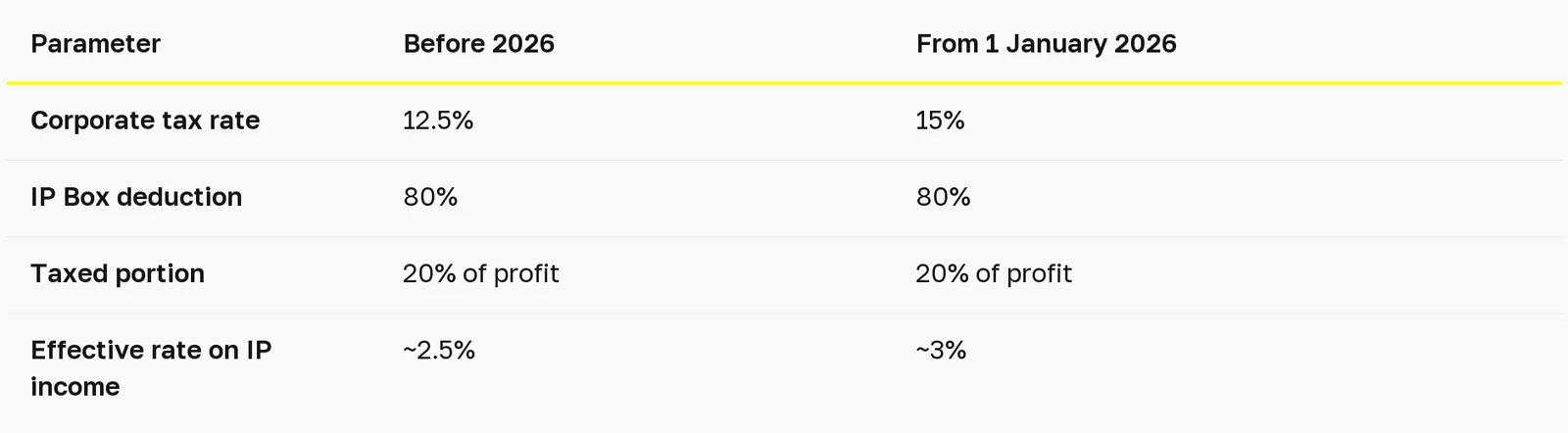
IP Box (the preferential tax regime for income from intellectual property) is built as a deduction. A company deducts 80% of its qualifying IP profit. The remaining 20% is taxed at the standard corporate rate. From 1 January 2026 that rate rose from 12.5% to 15%, after a tax reform passed parliament in December 2025. On IP income this gives an effective rate of about 3%: 15% on 20% of the profit. Before the reform it came to about 2.5%.
The 2026 reform left the mechanics of IP Box untouched. The 80% deduction and the nexus calculation stayed as they were. Only the base corporate tax rate went up.
IP income here means profit from using a qualifying asset: licence fees, royalties embedded in the price of the game, income from selling the rights.
What this looks like in money. On qualifying profit of €1 million, €200,000 falls into the tax base (that same 20%). At 15% this produces €30,000 of tax, which is 3% of the original million. The deduction covers the other €800,000.
Gamedev taxes in Cyprus: what qualifies for the relief
IP Box does not cover every kind of intellectual property. The regime is built on the OECD list, and for gamedev the distinction comes down to one thing.
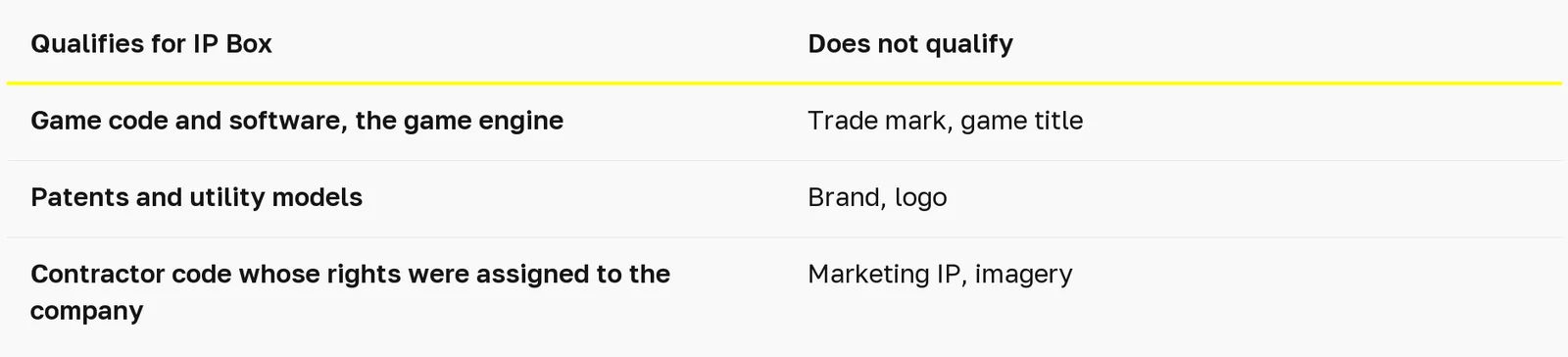
Game software and code, including the game engine, is a qualifying asset. That holds for code written by independent contractors brought in from outside. One caveat matters: art, music and audio do not qualify on their own — they are neither software nor patents, though they form part of the game.
In our practice the chain does not break on the contract — it breaks on the link to the deliverable: the contract exists, and there is no way to reconstruct which deliverable was accepted under it and when. The caveat above about art, music and audio has a sequel that shows up on our side of the work: since those assets bring no relief on their own, their rights get papered last — and they are what most often stops a release or a deal. A publisher or a buyer do not care whether an asset qualifies for the regime: what they need is an unbroken line of rights across the whole game. Hence a practical conclusion: it is easier to fix the transfer of rights at the moment a task is set than to dig through the archive before a round, and easier to keep the trace of acceptance where the team already works (in the tracker, in the repository, in the fact that files changed hands) having described in the contract beforehand what counts as acceptance. We work with distributed gamedev teams, and on our platform this part closes when the task is set: the contract, the task, acceptance and the fixing of rights collect into a single register for every contributor.
— comment by 4dev.com
The regime covers income from the game as an asset in the round: in-game purchases, copy sales and subscriptions qualify as income embedded in the product. Income from ad monetisation calls for a separate check: the tax authority's approach to it depends on whether the ads run through third-party networks or through your own platform. Trade marks, the game title, brand and imagery fall outside the relief: the OECD excluded them from the regime.
Hence the practical conclusion about structure. Keep the code in the Cypriot IP company, the one that receives the relief. Brand and trade marks will fall under ordinary corporate tax. Income tied to the code then runs at 3%, and the marketing side lives its own life with no claim to the relief.
The regime has a second benefit. Where the sale of a qualifying asset is capital in nature, the income from it falls outside corporate tax. A recharacterisation of the deal as a trading transaction brings the profit back into charge, so a sale of the game or its code is prepared in advance with a tax adviser.
Nexus: why independent contractors pay off
The size of the relief is limited by the nexus formula (the link between your development spending and the IP itself). The OECD logic is simple: the relief goes to whoever put their own money into creating the IP. Ready-made IP that was bought in gets trimmed out of the relief by the formula.
Qualifying profit is calculated like this:
QP = OI × (QE + UE) ÷ OE
What sits behind the letters:
The uplift is built so the numerator never exceeds the denominator: by construction the fraction cannot go above one. The point of the uplift is that a modest amount of related-party outsourcing or a small purchase should not cut the relief.
What does not count as qualifying expenditure: paying a structure related to you to do the development, your own offshore dev sub for example. That cost stays in the denominator and reaches the numerator only through the uplift.
An example with numbers. Overall expenditure on the asset is 100, of which 90 is your own (the in-house team and independent contractors) and 10 went to a related structure. The uplift equals the lower of two amounts: 30% of 90, which is 27, and the difference between 100 and 90, which is 10. Take 10. The fraction works out as (90 + 10) ÷ 100 = 1, so the relief runs on the whole of the qualifying profit.
A second example, where the uplift does not save you. Overall expenditure is 100, of which 50 is your own development and 50 is a purchase of ready-made code. The uplift equals the lower of 30% of 50 (that is 15) and the difference 100 − 50 (that is 50). Take 15. The fraction comes to (50 + 15) ÷ 100 = 0.65: 65% of the profit falls under the relief, and the remaining 35% is taxed at the ordinary rate.
Bought-in software
One thing gets missed most often at the planning stage. Where the product was bought rather than written by you from scratch — a ready-made engine, someone else's codebase, a whole game together with its team — the acquisition spend lands in OE, that is in the denominator, and never becomes qualifying expenditure.
The consequence is direct: the larger the share of your asset that was bought in, the less profit falls under the 3% rate. The uplift offsets this only partly, and only up to a ceiling of 30% of your own spending.
The practical takeaway for deals. Buying code, an engine or a studio is worth modelling with a tax adviser in advance: the purchase price moves both the balance sheet and the share of relieved profit for years ahead. And acquisition costs have to be evidenced by documents — they enter the calculation on the same footing as developer salaries.
For a studio with a distributed team of independent contractors this is a direct plus. Their pay goes into qualifying expenditure and lifts the share of profit under the relief. There is one condition: the contractors are genuinely independent, and the rights to their work passed to the Cypriot company. The second part takes us back to the chain of title.
Transferring game rights from a contractor
A qualifying asset is one over which the company has economic ownership. That is the basic condition for the relief, and it has to be proved: the defining feature of economic ownership is the exclusive right to the economic benefit from the asset.
This is exactly where an arrangement with contractors breaks. If the contractor is free to license the same code to other clients, your company holds no exclusive right to the benefit, and so no economic ownership. Without an assembled chain of title the asset also cannot be licensed, sold, or taken through due diligence.
A further difficulty is that economic ownership itself is not defined in the statute and no circular covers it. That is precisely why the practical answer is a single one: document everything and acquire the rights. In practice the tax authority expects the IP to sit on the company's balance sheet, backed by supporting documents; without them the questions land on the basis for the relief itself.
A Cypriot studio pays 3% on profit from a game only if it owns the rights to that game's code. Where part of the code, art or music was created by contractors brought in from outside, the question of who holds the rights is governed by the specific contract. Rights are assembled onto the company through separate documents, and here is what they consist of.
The chain of title is an unbroken documentary line from the author to the company. Under Cypriot copyright law (N. 59/1976) it carries strict requirements:
The developer contract for a game: what to check
What happens on the tax side without such a chain. Rights to part of the code stayed with the contractor, so the Cypriot company holds no economic ownership over that share of the IP. The profit attributable to it falls outside the relief. On audit this adds a risk of assessments and questions about the structure. That is why rights transfers are closed out before the game starts earning income, and before the company claims the IP Box regime.
Taken together, these documents deliver what a deal and a tax relief both require: a provable line of rights from every author to the company.
What makes a Cypriot company the owner of the IP
Assembled rights count for little if the Cypriot company looks like an empty shell. For the relief it has to be the economic owner of the IP: bearing the development risk and genuinely taking decisions in Cyprus. In practice documents evidence this:
This is practice built around the economic substance requirements. A company with no people and no decisions on the ground risks falling under the rules on empty structures, and the relief can then be withdrawn.
Global minimum tax (Pillar Two) is nothing to worry about while the group stays below the threshold. The rule applies only to groups with revenue of €750 million a year or more, and a typical studio is out of its reach. For a group inside the scope, an effective 3% is topped up to 15%, and Cyprus collects that top-up itself through its domestic minimum tax. A group in that position does not get the IP Box saving on this part.
How to assemble a structure for the 3% rate
STEP 1 — Separate code from brand
Code and your own game engine go into the Cypriot IP company under the relief. Brand and trade marks will fall under ordinary corporate tax.
STEP 2 — Collect rights from contractors
A written assignment of exclusive rights in every contract, with transfer as results are created and a list of results.
STEP 3 — Set up economic presence
A local director, an office, R&D cost records, the IP on the balance sheet, board minutes adopted in Cyprus.
STEP 4 — Check the nexus share
Payments to independent contractors go into qualifying expenditure; outsourcing to related structures and buying in ready-made IP lower the share.
We set up Cypriot IP structures for gamedev and build the chain of rights from contractors through to the company. That way income from the game falls under the 3% rate with no surprises on audit. We work with distributed teams from the US to Thailand.


Discuss
the Task
Speak to our team
Speak to our team. Tell us about your task –
we’ll help you with it in any jurisdiction.